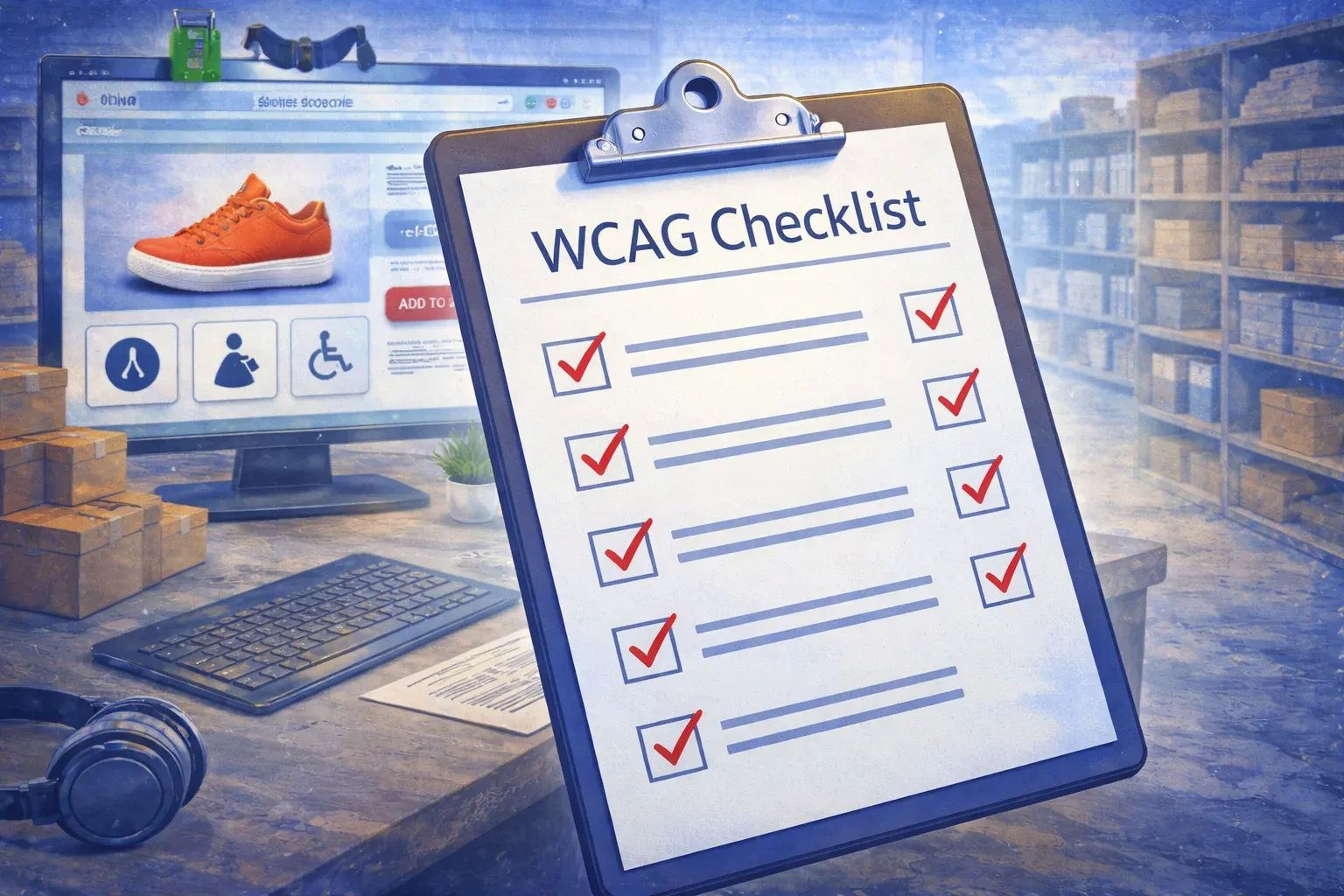
The Web Content Accessibility Guidelines (WCAG) are the global standard for digital accessibility. Designed to make web content more inclusive for people with disabilities, WCAG provides a clear framework for developers, designers, and business owners to follow. For e-commerce brands, understanding and implementing WCAG goes beyond compliance to creating a better experience for all users, increasing market reach, and reducing legal risk.
What is WCAG?
WCAG was developed by the World Wide Web Consortium (W3C) to help standardize web accessibility. The latest versions, WCAG 2.1 and WCAG 2.2, outline criteria for making websites accessible to users with visual, auditory, motor, and cognitive disabilities. These guidelines are referenced by major accessibility laws such as the Americans with Disabilities Act (ADA), the European Accessibility Act (EAA), and the UK Equality Act 2010.
The Four POUR principles
WCAG is structured around four foundational principles known as POUR:
Perceivable: Information must be presented in ways users can perceive, whether through sight, sound, or touch.
Operable: Navigation and controls must be usable through multiple input methods, like keyboards or screen readers.
Understandable: Content must be clear and predictable, supporting users with cognitive or learning disabilities.
Robust: Websites must function reliably with a wide range of technologies, including assistive devices.
Why should e-commerce brands care?
For e-commerce businesses, meeting WCAG standards is a smart business move for multiple reasons:
Reduces legal risk
In the US, non-compliance with WCAG is increasingly being interpreted as a violation of the ADA, leading to thousands of lawsuits annually. Similarly, the EAA and the UK Equality Act require accessible digital experiences. A site that meets accessibility standards reduces legal exposure in these key markets.
Expands customer base
WCAG was developed by the World Wide Web Consortium (W3C) to help standardize web accessibility. The latest versions, WCAG 2.1 and WCAG 2.2, outline criteria for making websites accessible to users with visual, auditory, motor, and cognitive disabilities. These guidelines are referenced by major accessibility laws such as the Americans with Disabilities Act (ADA), the European Accessibility Act (EAA), and the UK Equality Act 2010.
Builds trust and loyalty
Today's consumers expect brands to demonstrate values like inclusion and responsibility. By investing in accessibility, a business signals that it cares about all its customers. This helps build long-term trust and brand loyalty.
Boosts performance and conversion rates
Accessible websites often perform better as cleaner code, better user experience (UX), and improved search engine optimization (SEO) all contribute to higher engagement and conversion rates.
How an accessibility app can help
Implementing WCAG can be complex, but the right tools can simplify the process. An accessibility app offers no-code solutions that assist e-commerce teams to meet global standards like WCAG 2.1 and 2.2 with ease. It supports compliance with the ADA, EAA, and other legislation while also improving usability and peace of mind.
Accessibility is no longer a "nice-to-have". It's an essential component for protecting business interests from legal risk, growing audiences, and staying competitive in an increasingly inclusive digital landscape. WCAG provides the roadmap, and an accessibility app can help a business get there efficiently and affordably.