EnableAll logo
Back to Blog

Australia Disability Discrimination Act (DDA): What ecommerce brands need to know

DDA

09 Jun 20269 mins

Share

Australia Disability Discrimination Act (DDA): What ecommerce brands need to know

DDA

09 Jun 20269 mins

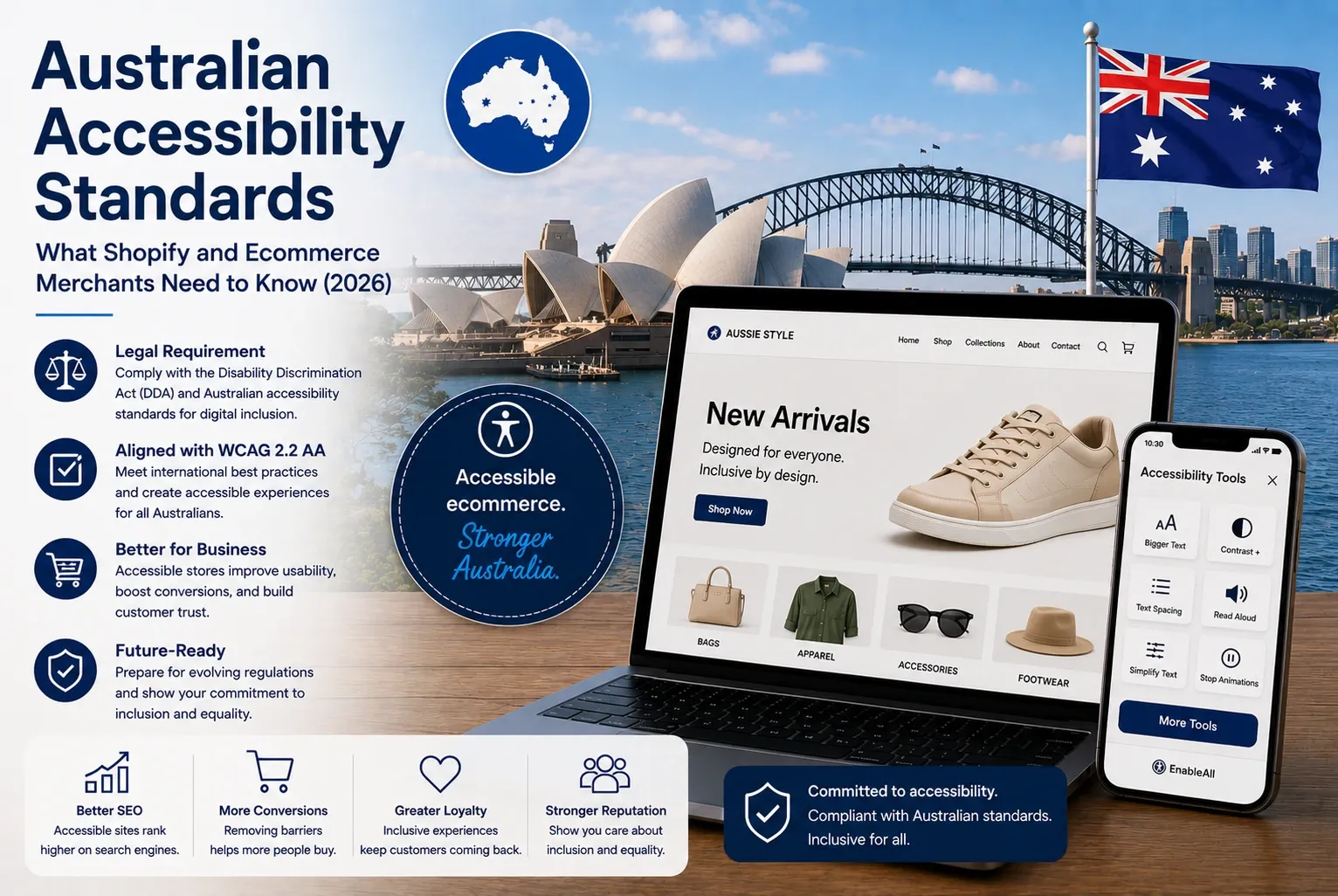
Australian accessibility standards infographic with the Sydney Opera House, beside an accessible online store.

Around one in five Australians lives with a disability. That’s more than 4.4 million people. It’s little wonder, then, that Australia also has one of the strongest disability-rights cultures, with digital accessibility expectations established across government, education, banking, travel, and online retail sectors.

The country’s long-standing Disability Discrimination Act (DDA) applies to websites, mobile apps, and online shopping experiences, particularly when disabled users are unable to access products, services, or information online.

For ecommerce brands selling to Australian consumers, accessibility is no longer simply about avoiding complaints. It increasingly affects customer trust, ecommerce growth, SEO performance, conversion rates, and brand reputation.

This article explains what the Australian DDA means for online retail businesses, how it aligns with WCAG accessibility standards, and what brands should do to improve accessibility across their digital stores.

What is the Disability Discrimination Act (DDA)?

Australia’s Disability Discrimination Act 1992 is a federal law designed to protect people with disabilities from discrimination across many areas of public life. The legislation applies to employment, education, transport, public services, accommodation, and businesses providing goods or services.

Importantly for ecommerce brands, the DDA also applies to websites and digital services. Under the Act, businesses must ensure that disabled people are not unfairly excluded from accessing products or services due to inaccessible systems or experiences.

Although the DDA does not specifically prescribe technical website standards, Australian regulators and courts increasingly rely on the Web Content Accessibility Guidelines (WCAG) as the practical benchmark for digital accessibility.

For ecommerce brands, this means online stores should be accessible to users who rely on:

  • Screen readers
  • Keyboard navigation
  • Voice controls
  • Captions
  • Cognitive accessibility tools
  • Assistive technologies

What does the DDA mean for ecommerce brands?

The DDA means accessibility should be considered part of delivering fair and equal access to online shopping experiences.

Modern ecommerce stores contain many interactive features that can create accessibility barriers, including:

  • Dynamic menus
  • Product filters
  • Image galleries
  • Promotional popups
  • Checkout systems
  • Account dashboards
  • Mobile interfaces
  • Third-party apps

If these experiences are inaccessible, disabled users may struggle to browse products, understand content, complete purchases, and navigate independently. This creates both legal and commercial risk.

Accessibility also affects how consumers perceive brands. Australian consumers are becoming more aware of inclusive design, ethical business practices, and digital accessibility expectations. For ecommerce brands, accessible experiences can support:

  • Stronger customer loyalty
  • Improved conversion performance
  • Broader audience reach
  • Better SEO outcomes
  • Improved usability for all users

Where is the DDA enforced?

Australia’s DDA applies broadly to any organization providing goods or services in Australia. If you run an online store that serves Australian customers, you are covered.

Importantly, the DDA also applies to overseas retailers. If you target Australian consumers — by accepting Australian dollars, shipping to Australian addresses, or running Australia-specific promotions — your website is regarded as a service under the Act.

Unlike some accessibility laws that impose specific technical standards, the DDA is enforced through a complaint-driven process. If a customer finds barriers on your website, they can file a complaint with the Australian Human Rights Commission (AHRC).

Many cases are resolved through conciliation, but if no agreement is reached, the issue can be escalated to the Federal Court, which has the authority to order compensation and corrective measures.

Which WCAG standard does the DDA require?

While the DDA does not explicitly reference WCAG, the AHRC and Australian courts generally treat WCAG 2.0 Level AA (and increasingly Level AA 2.1) as the benchmark.

The Australian Standard AS EN 301 549 also aligns with EU accessibility requirements and reinforces WCAG as the guiding framework.

The WCAG global accessibility standards are developed by the World Wide Web Consortium (W3C) and built around four principles:

  • Perceivable (Information should be presented in ways that all users can access, such as by providing alternative text for images)
  • Operable (Interfaces should be easy to navigate when using a variety of devices and assistive technologies).
  • Understandable (Content should be clear and predictable).
  • Robust (Websites and digital tools should work with a wide range of assistive technologies).

For ecommerce brands, this typically includes:

  • Image alt text
  • Keyboard accessibility
  • Form labels
  • Color contrast
  • Clear heading structures
  • Screen reader compatibility
  • Accessible checkout experiences

Who has to comply with the DDA?

The DDA broadly applies to businesses providing goods or services to the public. For ecommerce, this can include Shopify stores, ecommerce retailers, subscription businesses, online marketplaces, and mobile commerce platforms.

Unlike some legislation globally, the DDA does not contain a formal small-business exemption for accessibility obligations. This means businesses of all sizes may still face accessibility complaints if disabled users cannot access their services effectively.

If your store ships to Australian customers, accepts Australian payments, or markets to Australian consumers, accessibility should be treated as part of your broader customer experience and risk-management strategy.

What are the potential consequences if you don’t comply?

Under the DDA, inaccessible websites can lead to complaints being lodged with the Australian Human Rights Commission (AHRC). If conciliation fails, cases can escalate to the Federal Court, where businesses may be ordered to pay compensation and implement accessibility fixes.

Australian consumers are increasingly value-driven:

  • Brands perceived as inclusive and socially responsible garner greater trust and loyalty.
  • Accessible websites not only attract more customers but also decrease abandonment rates, resulting in fewer lost sales.

Accessibility improvements also contribute to stronger ESG (Environmental, Social, and Governance) credentials, which matter for investors, partners, and procurement processes.

What we can learn from Australian accessibility cases

While there aren’t thousands of lawsuits like in the US, the cases that have reached the Australian Human Rights Commission (AHRC) and the Federal Court have been highly influential. They show how inaccessible websites can put businesses at serious legal and reputational risk.

The Sydney Olympics (2000)

One of the world’s first high-profile web accessibility cases came from Australia. Bruce Maguire, a blind man, filed a complaint with the AHRC because the official Sydney 2000 Olympics website did not include alt text for images or provide accessible ticketing information.

The AHRC ruled in Maguire’s favour, determining that the site’s inaccessibility violated the DDA.

The ruling mandated accessibility improvements and established an international precedent that websites are regarded as ‘services’ under the law.

The case gained worldwide media attention and is still referenced today as a landmark judgment.

Lesson: Even globally significant brands are not immune. If the Olympics can be held accountable, so can any retailer.

Coles Online (2014)

In 2014, a blind woman lodged a complaint against Coles Supermarkets because its online shopping site was not compatible with screen readers.

The AHRC conciliation process failed, and the matter was escalated to the Federal Court.

While Coles eventually settled and upgraded its website, the case highlights the risks for mainstream e-commerce businesses.

The claimant's initial demand for millions in damages underscores the financial stakes.

Lesson: For e-commerce, inaccessible design doesn’t just risk complaints; it can escalate into costly, public legal disputes.

How should ecommerce merchants comply?

Accessibility should be integrated into ecommerce operations continuously rather than treated as a one-time project.

Recommended steps include:

1. Audit your website accessibility. Evaluate issues affecting:

  • Keyboard navigation
  • Screen readers
  • Forms
  • Ecommerce flows
  • Contrast ratios
  • Mobile usability

2. Align with WCAG 2.2 AA

WCAG 2.2 AA is becoming the practical benchmark for ecommerce accessibility in 2026.

3. Improve accessibility at the code level

Many accessibility issues exist within HTML structure, ARIA labels, forms, navigation, and semantic markups. Code-level remediation provides stronger accessibility support than surface-level adjustments alone.

4. Test accessibility regularly

Ecommerce stores constantly change product listings, apps, campaigns, themes, and promotions, so accessibility should be monitored continuously.

5. Include manual accessibility review

Automated testing alone cannot detect every accessibility issue. Human testing remains essential for identifying usability barriers and compatibility issues with assistive technology.

6. Publish an accessibility statement

An accessibility statement helps demonstrate transparency, commitment, and ongoing compliance efforts.

How can EnableAll help?

EnableAll is an accessibility platform built specifically for ecommerce environments. Rather than relying on overlay-based approaches, EnableAll focuses on automatic code-level accessibility improvements.

EnableAll helps merchants:

  • Improve WCAG alignment
  • Strengthen screen reader support
  • Improve keyboard accessibility
  • Reduce developer workload
  • Monitor accessibility continuously

Features include:

  • Automatic accessibility code-fix technology
  • Assist-Bar accessibility tools
  • Ecommerce-trained AI
  • Accessibility scanning and monitoring
  • Alt text support
  • Keyboard and screen reader enhancements
  • Accessibility statement support

The platform is designed to help ecommerce brands:

  • Reduce accessibility barriers
  • Improve the customer experience
  • Support WCAG 2.2 efforts
  • Improve accessibility without redesigning their store

Like all accessibility tools, EnableAll does not guarantee full legal compliance on its own, as accessibility requires ongoing monitoring and human review.

Frequently Asked Questions about the DDA

Does the DDA apply to ecommerce websites?

Yes. Australian disability law can apply to websites and digital services if disabled users cannot access them fairly.

Does Australia require WCAG compliance?

While the DDA does not explicitly reference WCAG, the AHRC and Australian courts generally treat WCAG 2.0 Level AA (and increasingly Level AA 2.1) as the benchmark.

Does the DDA apply to Shopify stores?

Yes. Shopify stores serving Australian consumers should consider accessibility obligations under the DDA.

Can international businesses face DDA complaints?

Potentially, yes — especially if they actively sell products or services to Australian consumers.

Does accessibility improve SEO?

Accessible websites often benefit from cleaner code, improved usability, stronger structure, and better crawlability, which may positively support SEO performance.

Can accessibility overlays guarantee compliance?

No. No overlay or automated accessibility tool can guarantee full compliance on its own.

Where should you go to learn more?

EnableAll resources

Final thoughts

Despite the DDA being in place for over 30 years, many Australian ecommerce businesses still fall short on accessibility. This creates a clear opportunity for forward-thinking retailers that wish to set themselves apart from competitors who are not yet compliant, boost conversions and revenue by lowering online barriers, and easily expand into other markets (such as the EU and the U.S.) because WCAG standards are recognised worldwide.

Many online retailers still treat accessibility as a compliance burden. In reality, accessible ecommerce experiences often create better usability for all customers while opening online stores to a wider audience. Retailers that invest early in accessibility are likely to be better positioned for long-term growth, stronger customer loyalty, and evolving global accessibility expectations.

This web page is provided for informational purposes only and should not be considered legal advice. Please consult with a legal professional before taking any action.

In just a few clicks.

EnableAll accessibility widget icon
Facegym logo
Unhidden logo
BuDaGirl logo
Sabatino logo
Trend Tonic logo
Antler logo