Americans with Disabilities Act (ADA): What ecommerce brands need to know
Americans with Disabilities Act
09 Jun 2026 • 11 mins
Americans with Disabilities Act (ADA): What ecommerce brands need to know
Americans with Disabilities Act
09 Jun 2026 • 11 mins
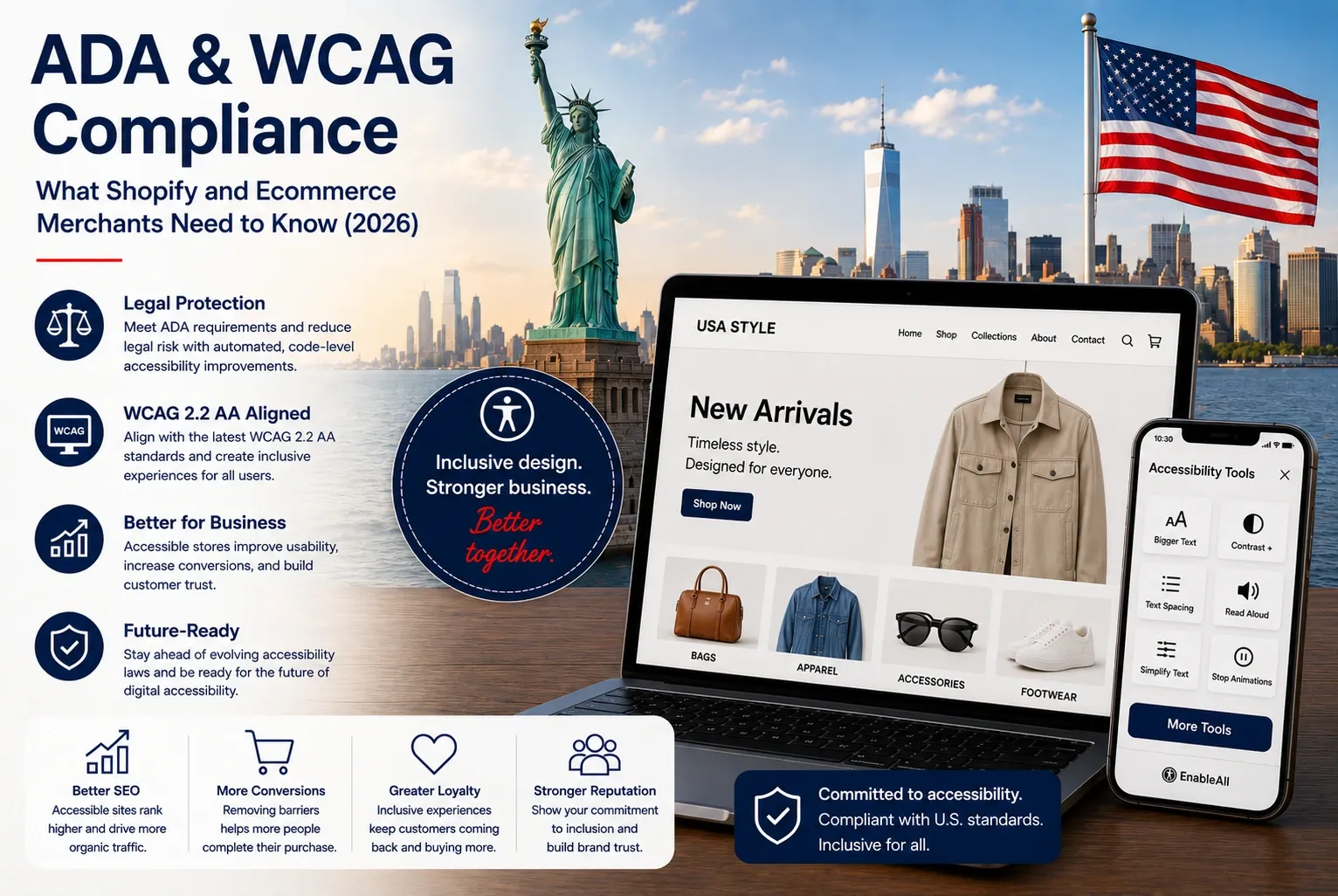
The Americans with Disabilities Act (ADA) is the most influential accessibility law affecting ecommerce businesses in the United States. Over the last decade, digital accessibility lawsuits involving websites and online stores have increased dramatically, with ecommerce brands among the most heavily targeted sectors. If your online store sells products or services to customers in the United States, multiple U.S. courts and the Department of Justice (DOJ) have said that the ADA applies and accessibility should now be viewed as a core part of risk management, the customer experience, your SEO strategy, and long-term brand trust.
This guide explains what the ADA means for ecommerce brands in 2026, how it aligns to WCAG accessibility standards, and how you can improve accessibility across your digital storefronts.
What is the Americans with Disabilities Act (ADA)?
The Americans with Disabilities Act (ADA) is a US civil rights law introduced in 1990 to protect people with disabilities from discrimination. The law applies across many areas of public life, including employment, transportation, telecommunications, public accommodations, and businesses serving the public.
Although the ADA was enacted before modern ecommerce existed, US courts increasingly interpret websites and digital services as part of Title III, which covers places of ‘public accommodation’.
Historically, Title III referred to physical spaces such as shops, hotels, and restaurants. But as the internet has become essential to everyday life, US courts and the Department of Justice (DOJ) have repeatedly confirmed that websites and mobile apps are also subject to Title III.
As a result, ecommerce websites are now regularly challenged under the ADA when disabled users encounter accessibility barriers that prevent equal access. For online retailers, this means websites and digital experiences should be accessible to users who rely on screen readers, keyboard navigation, captions, voice technology, assistive devices, and cognitive accessibility tools.
Download our free guide to the ADA.
Want more? Our free 32 page PDF contains all the information you need about the American's with Disabilities Act. Packed with useful advice it details how you can reduce your legal risk and become more compliant.
What does the ADA mean for ecommerce brands?
The ADA has become particularly important for ecommerce businesses because online retail environments contain many interactive elements that can create accessibility barriers.
Examples include:
- Product filtering tools
- Image galleries
- Dynamic menus
- Popups
- Checkout forms
- Payment systems
- Account dashboards
- Third-party apps
If these experiences are inaccessible, users may be unable to browse products, complete purchases, understand content, and navigate independently - creating both legal exposure and lost revenue opportunities.
Ecommerce businesses now represent the largest category of digital accessibility lawsuits in the United States. Accessibility also directly affects conversion rates, customer satisfaction, SEO visibility, bounce rates, and customer retention. As consumers place greater importance on inclusive online experiences, digital accessibility is the competitive advantage you can’t ignore.
Where is the ADA enforced?
The ADA applies throughout the United States. It is enforced primarily through lawsuits.
Thousands of ADA web accessibility cases are filed in the US every year, with settlements ranging from $5,000 to $20,000 per case, plus legal fees and remediation costs. States such as New York, California, and Florida have seen particularly high volumes of digital accessibility litigation.
Importantly, non-US ecommerce businesses may also face ADA exposure if you:
- Sell products to US customers
- Ship within the United States
- Market to US consumers
- Accept American dollars
Which WCAG standard does the ADA require?
The ADA itself does not explicitly mandate a specific WCAG version. Instead, the DOJ and US courts consistently reference the Web Content Accessibility Guidelines (generally WCAG 2.1, Level AA) as the baseline for compliance.
The WCAG global accessibility standards are developed by the World Wide Web Consortium (W3C) and built around four principles:
- Perceivable (Information should be presented in ways that all users can access, such as by providing alternative text for images)
- Operable (Interfaces should be easy to navigate when using a variety of devices and assistive technologies).
- Understandable (Content should be clear and predictable).
- Robust (Websites and digital tools should work with a wide range of assistive technologies).
For ecommerce brands, this typically includes:
- Image alt text
- Keyboard accessibility
- Form labels
- Color contrast
- Clear heading structures
- Screen reader compatibility
- Accessible checkout experiences
Who has to comply with the ADA?
The ADA broadly applies to businesses considered places of ‘public accommodation’ under Title III regulations. For ecommerce, this can include Shopify stores, ecommerce retailers, subscription businesses, online marketplaces, and mobile commerce platforms.
The ADA does not have a small-business exemption. Even a one-person online store can face legal action. In practice, ADA-related lawsuits have targeted enterprise retailers, mid-sized brands, small ecommerce businesses, and international businesses selling into the US. If your store serves American customers, accessibility should be treated as part of your broader operational and customer experience strategy.
ADA lawsuit growth
In 2023, plaintiffs filed 3,086 ADA web accessibility lawsuits in Federal courts and 1,519 in State courts, totaling 4,605 cases.
That’s up from just over 4,000 the year before, a steady year-on-year increase.
The majority of cases targeted ecommerce websites, making online retail the most at-risk sector.
Thousands of additional demand letters (settlement threats before court) never even make it into the official statistics.
(Source: UsableNet ADA Digital Accessibility Lawsuit Report 2023)
What are the potential consequences if you don’t comply?
Potential consequences may include:
Civil penalties: As of July 3, 2025, under Title III, the DOJ can levy fines of up to $118,225 for a first violation and $236,451 for subsequent violations (fine levels are adjusted for inflation each year). Private plaintiffs can also seek payment of their attorneys’ fees, which often amount to thousands of dollars or more.
State laws: In some states, additional rules apply. For example, California’s Unruh Civil Rights Act sets damages at around $4,000 per violation and is often combined with ADA lawsuits.
Settlements: Most businesses settle cases before trial, with payouts often thousands of dollars or more per case, plus attorney’s fees and the cost of fixing the website.
Reputation risk: Public lawsuits can damage brand trust, especially if your business is seen as resisting accessibility.
The ecommerce sector has experienced a sharp increase in digital accessibility claims over recent years. Common accessibility issues cited in lawsuits include missing alt text, inaccessible forms, keyboard traps, poor screen reader compatibility, and inaccessible checkout systems.
What we can learn from litigation examples
One of the most striking features of ADA enforcement is that lawsuits, rather than proactive inspections, drive it. For ecommerce brands, this means that case law shapes the rules as much as the statute itself. A few high-profile cases illustrate the risks.
Domino’s Pizza (2016–2019)
A blind customer sued Domino’s because he could not order food on its website and mobile app using a screen reader. Domino’s argued the ADA didn’t apply to websites and mobile applications, but the courts disagreed. After appeals up to the Supreme Court (which declined to hear Domino’s petition), the company was forced to remediate its site.
Lesson: The ADA has been applied to websites and apps. Ignoring digital accessibility is no longer a defensible position.
Netflix (2012)
A federal court in Massachusetts refused to dismiss an ADA claim brought by the National Association of the Deaf against Netflix for failure to include closed captioning on Netflix’s streamed videos. The Court held that Netflix’s movie streaming platform is a place of public accommodation subject to the ADA.
Lesson: This case shows that online-only businesses, including streaming services, are subject to the ADA and should be accessible.
Target (2006)
After a court held that Target’s website needed to be accessible to the blind, Target settled a class-action lawsuit brought by the National Federation of the Blind over its inaccessible website. The settlement required Target to pay $6 million and commit to long-term accessibility improvements.
Lesson: Settlements can be costly, both financially and reputationally. Major retailers are not immune.
Beyoncé’s Website (2019)
A blind woman sued the official Beyoncé site, alleging it lacked alt text, keyboard navigation, and other WCAG basics. The case highlighted that even entertainment and celebrity websites are subject to ADA requirements.
Lesson: No business is ‘too small’ or ‘too unique’ to be sued. If you sell or promote to U.S. customers online, you’re at risk.
Beyond legal exposure, inaccessible ecommerce experiences can also lead to:
- Abandoned carts
- Lost customer trust
- Lower conversion rates
- Negative publicity
- Weaker SEO performance
How should ecommerce brands comply?
Accessibility should be integrated into ecommerce operations continuously rather than treated as a one-time project.
Recommended steps include:
1. Audit your website accessibility. Evaluate issues affecting:
- Keyboard navigation
- Screen readers
- Forms
- Ecommerce flows
- Contrast ratios
- Mobile usability
2. Align with WCAG 2.2 AA
WCAG 2.2 AA is becoming the practical benchmark for ecommerce accessibility in 2026.
3. Improve accessibility at the code level
Many accessibility issues exist within HTML structure, ARIA labels, forms, navigation, and semantic markups. Code-level remediation provides stronger accessibility support than surface-level adjustments alone.
4. Test accessibility regularly
Ecommerce stores constantly change product listings, apps, campaigns, themes, and promotions, so accessibility should be monitored continuously.
5. Include manual accessibility review
Automated testing alone cannot detect every accessibility issue. Human testing remains essential for identifying usability barriers and compatibility issues with assistive technology.
6. Publish an accessibility statement
An accessibility statement helps demonstrate transparency, commitment, and ongoing compliance efforts.
How can EnableAll help?
EnableAll is an accessibility platform built specifically for ecommerce environments. Rather than relying on overlay-based approaches, EnableAll focuses on automatic code-level accessibility improvements.
EnableAll helps merchants:
- Improve WCAG alignment
- Strengthen screen reader support
- Improve keyboard accessibility
- Reduce developer workload
- Monitor accessibility continuously
Features include:
- Automatic accessibility code-fix technology
- Assist-Bar accessibility tools
- Ecommerce-trained AI
- Accessibility scanning and monitoring
- Alt text support
- Keyboard and screen reader enhancements
- Accessibility statement support
The platform is designed to help ecommerce brands:
- Reduce accessibility barriers
- Improve the customer experience
- Support WCAG 2.2 efforts
- Improve accessibility without redesigning their store
Like all accessibility tools, EnableAll does not guarantee full legal compliance on its own, as accessibility requires ongoing monitoring and human review.
Frequently Asked Questions about the ADA
Does the ADA apply to ecommerce websites?
Yes. US courts increasingly interpret ecommerce websites as places of ‘public accommodation’ under Title III regulations.
Does the ADA require WCAG 2.2?
The ADA does not specifically mandate WCAG 2.2, but many organizations are adopting WCAG 2.2 AA as best practice.
Can international businesses face ADA lawsuits?
Yes. Non-US businesses selling to US customers may still face accessibility-related legal exposure.
Are Shopify stores covered by the ADA?
Yes. Shopify stores serving US consumers should consider ADA accessibility expectations.
Can accessibility overlays guarantee compliance?
No. No overlay or automated tool can guarantee full accessibility compliance on its own.
Where should you go to learn more?
Official resources
Related accessibility resources
EnableAll resources
Final thoughts
Many businesses still see accessibility as a burden. The truth is, it’s an opportunity. By ensuring your online store is ADA-compliant and WCAG-aligned, you will future-proof your business against litigation, gain an advantage over competitors who exclude a quarter of the US population, and strengthen your reputation as an inclusive, customer-first brand.
Accessibility under the ADA isn’t just about avoiding fines; it’s about unlocking growth. Retailers who act now will not only comply with the law but will also tap into a vast, loyal, and underserved market. Instead of seeing ADA compliance as a challenge, view it as a valuable opportunity for your business. It offers a way to innovate, expand your audience, and enhance your brand reputation. This isn’t just about ticking a legal box. Getting accessibility right helps you reach more people, grow your brand, and do the right thing.
This web page is provided for informational purposes only and should not be considered legal advice. Please consult with a legal professional before taking any action.