EnableAll logo
Back to Blog

Brazilian Inclusion Law (LBI): What ecommerce brands need to know

LBI

09 Jun 20268 mins

Share

Brazilian Inclusion Law (LBI): What ecommerce brands need to know

LBI

09 Jun 20268 mins

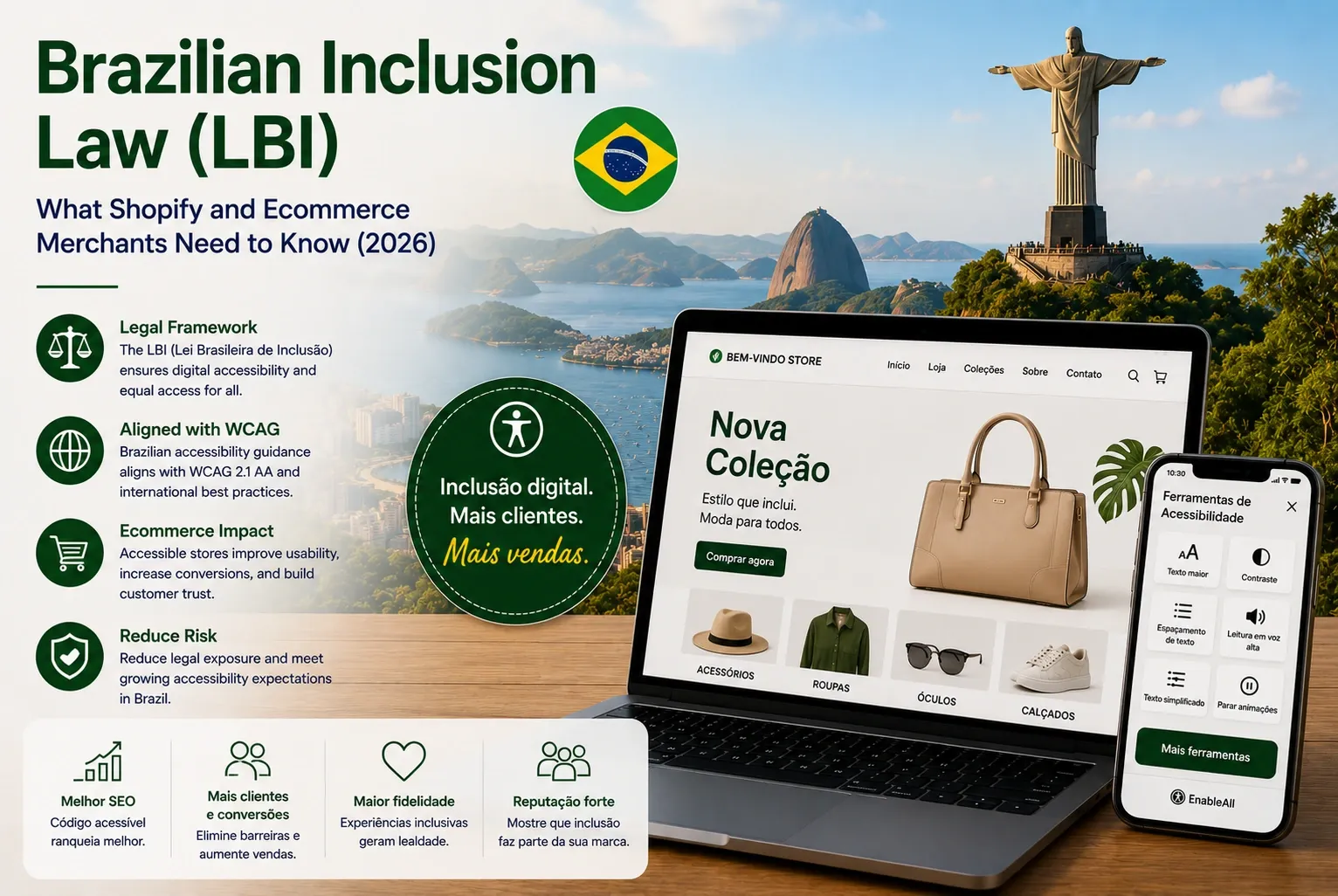
Brazilian Inclusion Law infographic with Christ the Redeemer and a laptop showing an accessible store in Portuguese.

The Brazilian LBI (Lei Brasileira de Inclusão (PDF), or the Brazilian Inclusion Law) is a sweeping civil rights legislation (Federal Law No. 13.146) passed in 2015 to guarantee, protect, and promote the fundamental rights and freedoms of persons with disabilities. Also known as the Estatuto da Pessoa com Deficiência (Statute of Persons with Disabilities), it took effect in 2016 and applies to an estimated 45 million Brazilians.

The LBI introduced broad accessibility obligations across physical and digital environments, including websites, ecommerce platforms, and online services. For ecommerce brands operating in Brazil or selling to Brazilian consumers, accessibility increasingly affects legal compliance, customer trust, SEO visibility, ecommerce growth, and brand reputation.

This article explains what the LBI means for ecommerce businesses in 2026, how it aligns with WCAG accessibility standards, and what retail brands should know about digital accessibility obligations in Brazil.

What is the Brazilian Inclusion Law (LBI)?

Brazil’s Lei Brasileira de Inclusão (LBI) was introduced to strengthen the rights and inclusion of approximately 45 million people with disabilities (23.9% of the Brazilian population). It defines a person with disability as someone with any long-term physical, mental, intellectual, or sensory impediment, in line with the 2006 United Nations Convention.

Importantly for ecommerce retailers, the LBI explicitly includes expectations for digital accessibility. This means websites and digital platforms should be accessible to disabled users and compatible with assistive technologies.

Although the LBI does not directly prescribe a single technical website standard, accessibility expectations in Brazil strongly align with WCAG principles.

For ecommerce brands, this means websites should support users who rely on:

  • Screen readers
  • Keyboard navigation
  • Captions
  • Voice controls
  • Magnification tools
  • Assistive technologies

What does the LBI mean for Shopify and ecommerce merchants?

Brazil’s ecommerce market is highly digital, mobile-driven, and rapidly growing. For online retail brands, the LBI means accessibility should increasingly be treated as part of digital inclusion, the customer experience, and operational risk management.

Modern ecommerce stores contain many interactive features that can create accessibility barriers, including:

  • Dynamic menus
  • Product filters
  • Image galleries
  • Promotional popups
  • Checkout systems
  • Account dashboards
  • Mobile interfaces
  • Third-party apps

If these experiences are inaccessible, disabled users may struggle to browse products, understand content, complete purchases, and navigate independently. This creates both legal and commercial risk.

Accessibility also increasingly affects how consumers perceive brands. Brazilian consumers are becoming more aware of inclusive design, ethical business practices, and digital accessibility expectations.

For ecommerce brands, accessible experiences can support:

  • Stronger customer loyalty
  • Improved conversion performance
  • Broader audience reach
  • Better SEO outcomes
  • Improved usability for all users

Where is the LBI enforced?

The Brazilian Inclusion Law applies nationwide. Accessibility expectations affect both public-sector organizations and private-sector businesses, including ecommerce businesses operating digitally within Brazil.

The law impacts:

  • Brazilian ecommerce companies
  • International retailers targeting Brazilian consumers
  • Businesses operating Portuguese-language digital storefronts
  • Companies accepting Brazilian payments or shipping to Brazil

Enforcement may involve:

  • Legal complaints
  • Regulatory investigations
  • Consumer protection actions
  • Reputational pressures

Brazil’s legal and consumer-rights environment is relatively active compared with other emerging ecommerce markets from BRICS countries.

Which WCAG standard does the LBI require?

Brazilian accessibility guidance strongly aligns with WCAG accessibility standards. Brazil has historically referenced both WCAG 2.0 and WCAG 2.1 through broader accessibility and digital inclusion frameworks.

The WCAG global accessibility standards are developed by the World Wide Web Consortium (W3C) and built around four principles:

  • Perceivable (Information should be presented in ways that all users can access, such as by providing alternative text for images)
  • Operable (Interfaces should be easy to navigate when using a variety of devices and assistive technologies).
  • Understandable (Content should be clear and predictable).
  • Robust (Websites and digital tools should work with a wide range of assistive technologies).

For ecommerce brands, this typically includes:

  • Image alt text
  • Keyboard accessibility
  • Form labels
  • Color contrast
  • Clear heading structures
  • Screen reader compatibility
  • Accessible checkout experiences

Who has to comply with the LBI?

The LBI broadly applies to organizations providing services to the public. For ecommerce, this can include Shopify stores, online retailers, subscription businesses, marketplaces, and mobile commerce platforms.

Accessibility expectations apply to businesses operating in Brazil that target Brazilian consumers, provide Portuguese-language digital services, or ship products to Brazilian customers. Even international ecommerce brands may face accessibility expectations if they actively serve the Brazilian market.

What are the potential consequences if you don’t comply?

In Brazil, accessibility enforcement is driven not only by individuals but also by the Public Prosecutor's Offices (Ministério Público). These authorities can investigate organizations where inaccessible digital services are viewed as discriminatory or exclusionary.

Potential consequences may include:

  • Legal complaints
  • Consumer protection claims
  • Reputational damage
  • Remediation costs
  • Customer dissatisfaction

Inaccessible ecommerce experiences may also contribute to:

  • Abandoned purchases
  • Weaker conversion performance
  • Customer frustration
  • SEO disadvantages

As ecommerce adoption expands across Latin America, expectations for digital accessibility are also rising. Brazilian regulators and advocacy groups have become increasingly vocal about digital inclusion, equal access to services, and accessible technology

Businesses that invest early in online accessibility may gain advantages such as broader customer reach, stronger customer trust, improved usability, and greater international readiness.

Mobile accessibility is increasingly important

Brazil is a highly mobile-first ecommerce market, with many consumers relying on their smartphones for online shopping. This means accessibility issues affecting touch targets, responsive layouts, mobile navigation, screen reader compatibility, and mobile checkout experiences

can create both usability problems and increased legal and reputational risk for ecommerce brands.

How should ecommerce brands comply?

Accessibility should be integrated into ecommerce operations continuously rather than treated as a one-time project.

Recommended steps include:

1. Audit your website accessibility. Evaluate issues affecting:

  • Keyboard navigation
  • Screen readers
  • Forms
  • Ecommerce flows
  • Contrast ratios
  • Mobile usability

2. Align with WCAG 2.2 AA

WCAG 2.2 AA is becoming the practical benchmark for ecommerce accessibility in 2026.

3. Improve accessibility at the code level

Many accessibility issues exist within HTML structure, ARIA labels, forms, navigation, and semantic markups. Code-level remediation generally provides stronger accessibility support than surface-level adjustments alone.

4. Test accessibility regularly

Ecommerce stores constantly change product listings, apps, campaigns, themes, and promotions, so accessibility should be monitored continuously.

5. Include manual accessibility review

Automated testing alone cannot detect every accessibility issue. Human testing remains essential for identifying usability barriers and compatibility issues with assistive technology.

6. Publish an accessibility statement

An accessibility statement helps demonstrate transparency, commitment, and ongoing compliance efforts.

How can EnableAll help?

EnableAll is an accessibility platform built specifically for ecommerce environments. Rather than relying on overlay-based approaches, EnableAll focuses on automatic code-level accessibility improvements.

EnableAll helps online retailers:

  • Improve WCAG alignment
  • Strengthen accessibility support
  • Reduce developer workload
  • Avoid heavy scripts that can impact performance

EnableAll includes:

  • Automatic accessibility code-fix technology
  • Assist-Bar accessibility tools
  • Ecommerce-trained AI
  • Accessibility scanning and monitoring
  • Alt text support
  • Keyboard and screen reader enhancements
  • Accessibility statement support

The platform is designed to help ecommerce brands:

  • Reduce accessibility barriers
  • Improve the customer experience
  • Support WCAG 2.2 efforts
  • Improve accessibility without redesigning their store

Like all accessibility tools, EnableAll does not guarantee full legal compliance on its own, as accessibility requires ongoing monitoring and human review.

Frequently Asked Questions about the LBI

Does the LBI apply to ecommerce websites?

Yes. Brazil’s accessibility law increasingly applies to websites and digital services.

Does Brazil require WCAG compliance?

Brazilian accessibility expectations strongly align with WCAG standards.

Does the LBI apply to Shopify stores?

Potentially, yes — especially if your store targets Brazilian consumers or operates within Brazil.

Is Brazil strict about accessibility?

Accessibility expectations and enforcement activity are increasing across Brazil’s digital economy.

Can accessibility overlays guarantee compliance?

No. No overlay or automated accessibility tool can guarantee full compliance on its own.

Official resources

Brazilian digital accessibility guidance

W3C Web Content Accessibility Guidelines (WCAG)

WCAG 2.2 AA guidance

WCAG 2.1 AA guidance

EnableAll resources

Final thoughts

Brazil's ecommerce market is large enough to attract significant regulatory attention to consumer rights violations and is one of the most important emerging accessibility markets for global ecommerce brands. For online retailers, this creates a clear strategic opportunity. Many ecommerce businesses operating in Brazil still have significant accessibility gaps across mobile experiences, checkout flows, navigation systems, and screen reader compatibility. Retailers that improve accessibility early can differentiate themselves in a highly competitive market while building stronger experiences for all users.

Brazil also highlights a broader international reality - accessibility expectations are no longer limited to North America and Europe. As countries around the world strengthen digital inclusion efforts, ecommerce businesses increasingly need accessibility strategies that scale globally across multiple legal frameworks, languages, devices, and customer needs.

For merchants planning long-term international growth, accessibility is becoming part of modern ecommerce infrastructure — not simply a compliance checkbox.

This web page is provided for informational purposes only and should not be considered legal advice. Please consult with a legal professional before taking any action.

In just a few clicks.

EnableAll accessibility widget icon
Facegym logo
Unhidden logo
BuDaGirl logo
Sabatino logo
Trend Tonic logo
Antler logo