EnableAll logo
Back to Blog

E-commerce rules are changing. Is your website ready?

European Accessibility Act

02 Apr 20262 mins

Share

E-commerce rules are changing. Is your website ready?

European Accessibility Act

02 Apr 20262 mins

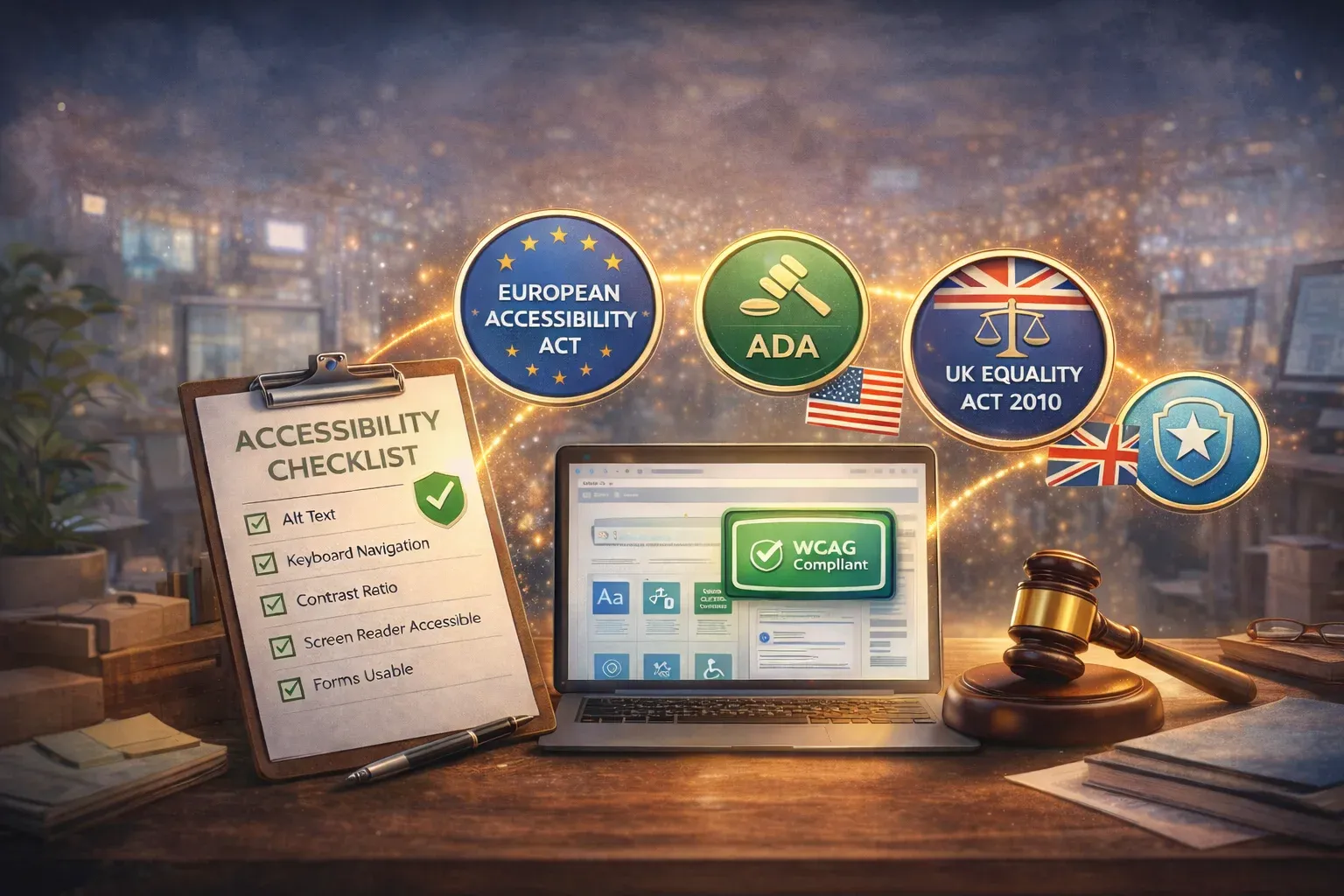
Clipboard showing a completed accessibility checklist beside a laptop and symbols for EU, US and UK regulations.

E-commerce is evolving, and so are the rules that govern it. With the European Accessibility Act (EAA), which came into effect in June 2025, along with stricter enforcement of the Americans with Disabilities Act (ADA) in the United States and similar mandates under the UK Equality Act 2010, digital accessibility is no longer a nice-to-have; it’s a legal and commercial imperative. 

So, what does that mean for your online business?

The new regulatory landscape

The EAA requires all digital services and e-commerce platforms operating in the European Union (EU) to meet strict accessibility standards. Products and services that do not comply cannot be legally sold in the EU. Meanwhile, in the US, lawsuits under the ADA continue to rise, with more than 11,000 filed between 2017 and 2023 (ecomback, 2023). 

These changes affect businesses of all sizes, but small- and medium-sized companies are especially vulnerable. Usablenet (2024) reports that more than 66% of ADA lawsuits target businesses earning under $25 million annually. 

Why accessibility matters

Accessibility is about more than avoiding fines. Over 135 million people in the EU live with a disability, and globally, the accessible market represents $8 trillion in annual disposable income (WHO, 2023). Inaccessible websites miss out on this revenue. In fact, 70% of disabled users abandon sites they can’t navigate, a phenomenon known as the “Click-Away Pound”.

How an accessibility app can help

To meet compliance standards efficiently and cost-effectively, many e-commerce businesses are turning to accessibility apps. Here's why:

Reduce legal risk

Accessibility apps that meet Web Content Accessibility Guidelines (WCAG 2.1) AA and AAA standards help your business align with global laws like the ADA, EAA, and the UK Equality Act 2010, without expensive developer time or manual intervention.

Increase revenue

Accessible websites convert better. They enjoy lower bounce rates, better navigation, and more repeat purchases. Industry reports and case studies show accessible websites experience 20% to 30% higher conversion rates, and 15% to 20% more organic traffic.

Drive long-term growth

Accessibility also boosts your brand reputation. Consumers, especially Millennials and Gen Z, are values-driven, with 82% preferring to buy from inclusive brands and 64% willing to pay more for ethically aligned businesses (Cone/Porter Novelli, 2018). An accessible, inclusive website also strengthens SEO and reduces future compliance costs.

The bottom line

E-commerce compliance isn't optional in 2025. With global regulations tightening, businesses need scalable, automated solutions that ensure legal compliance, improve customer experience, and unlock new revenue streams. An accessibility app offers all of this and future-proofs your digital storefront.

In just a few clicks.

EnableAll accessibility widget icon
Facegym logo
Unhidden logo
BuDaGirl logo
Sabatino logo
Trend Tonic logo
Antler logo