EN 301 549: What ecommerce brands need to know
European Accessibility Act
09 Jun 2026 • 9 mins
EN 301 549: What ecommerce brands need to know
European Accessibility Act
09 Jun 2026 • 9 mins
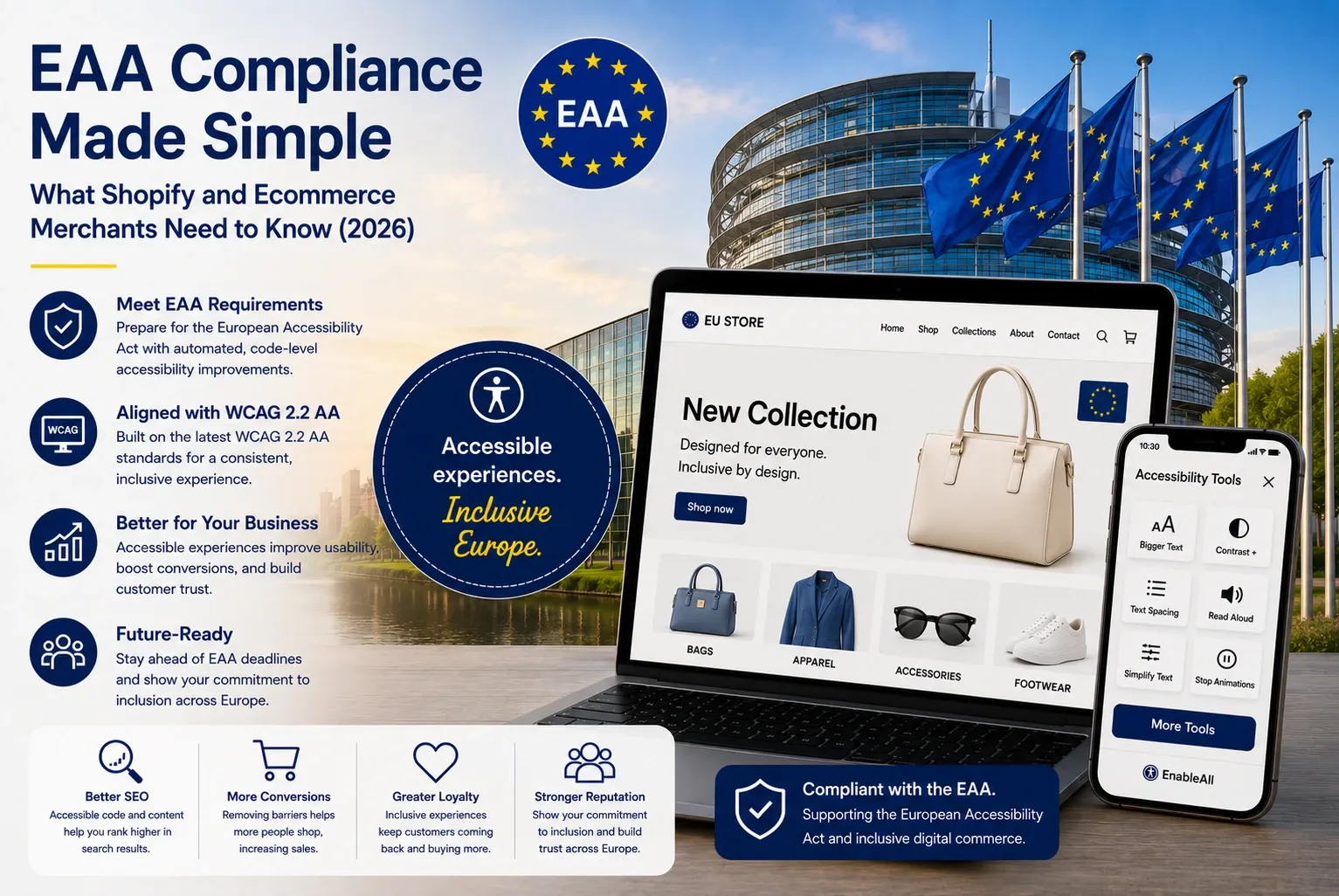

If your ecommerce business sells products or services to customers in the European Union (EU), you’ve probably encountered references to EN 301 549 while researching the European Accessibility Act (EAA), WCAG compliance, or digital accessibility requirements.
But what exactly is EN 301 549? How does it relate to WCAG? And does it apply to ecommerce?
This article explains what EN 301 549 means for online retail brands, how it connects to the EAA, and why understanding the relationship between EN 301 549 and WCAG is increasingly important for online retail success.
What is EN 301 549?
EN 301 549 is the European Union’s technical accessibility standard for Information and Communication Technology (ICT).
In practical terms, it provides the technical accessibility requirements used to support compliance with European accessibility legislation, including the European Accessibility Act (EAA).
The standard covers accessibility requirements for:
- Websites
- Ecommerce platforms
- Mobile apps
- Software
- Digital documents
- Self-service terminals
- Telecommunications
- Video and multimedia content
- Electronic communication services
EN 301 549 was developed by European standards organizations to create a consistent accessibility framework across EU member states.
Importantly for ecommerce businesses:
- EN 301 549 heavily incorporates WCAG requirements.
- This is why the terms “EN 301 549” and “WCAG” are often discussed together.
Why EN 301 549 matters for ecommerce
For many online retail brands, EN 301 549 becomes relevant because it underpins how accessibility is assessed under the European Accessibility Act (EAA).
If your ecommerce business sells products or services into the EU, accessibility expectations increasingly reference: EN 301 549, WCAG, and the EAA.
This matters because ecommerce websites contain many accessibility-sensitive user journeys, including:
- Product browsing
- Search and filtering
- Navigation menus
- Shopping carts
- Checkout flows
- Customer account areas
- Payment systems
If these experiences are inaccessible, users with disabilities may struggle to browse products, understand product information, complete purchases, and use assistive technologies effectively.
For ecommerce brands, EN 301 549 is therefore not just a ‘technical government standard’. It increasingly shapes:
- Ecommerce compliance expectations
- Accessibility audits
- Procurement requirements
- Legal risk assessments
- Accessibility best practices
Accessibility also carries major commercial implications:
- Accessible ecommerce stores can improve conversion opportunities
- Accessible websites often support stronger SEO performance
- Inclusive customer experiences build loyalty and trust
- Inaccessible websites can lead to customer abandonment and reputational harm
Where is EN 301 549 used?
EN 301 549 is used across the European Union as the harmonized technical accessibility standard supporting EU accessibility legislation.
It is particularly important in:
- EU member states
- Public sector procurement
- Accessibility compliance assessments
- European Accessibility Act (EAA) implementation
Although it is a European standard, EN 301 549 can affect businesses globally if they:
- Sell into Europe
- Provide digital services to EU users
- Work with European organizations
- Participate in EU procurement environments
For ecommerce brands, the standard is increasingly relevant because the EAA applies to many digital services provided to EU consumers, regardless of where the business is headquartered.
How does EN 301 549 relate to WCAG?
This is one of the most common questions ecommerce merchants ask: “What’s the difference between EN 301 549 and WCAG?”
The short answer:
- WCAG is part of EN 301 549.
WCAG (Web Content Accessibility Guidelines) is the global accessibility standard created by the World Wide Web Consortium (W3C).
EN 301 549 incorporates WCAG requirements while adding broader European ICT accessibility requirements that extend beyond websites.
EN 301 549 vs WCAG
Which WCAG version does EN 301 549 use?
EN 301 549 aligns primarily with WCAG 2.1 AA
Many organizations are transitioning toward WCAG 2.2 AA
Future updates are expected to continue evolving alongside WCAG
For ecommerce brands, WCAG 2.2 AA is increasingly viewed as the safest and most future-ready benchmark.
Which WCAG areas matter most for ecommerce?
For ecommerce websites, the most commercially important WCAG areas typically include:
Perceivable
Image alt text, Captions, Color contrast, Readable typography
Operable
Keyboard navigation, Accessible menus, Usable checkout flows, Skip links
Understandable
Clear forms, Predictable navigation, Readable content, Error prevention
Robust
Screen reader compatibility, Semantic HTML, ARIA labels, Compatibility with assistive technologies
These accessibility foundations are particularly important in ecommerce because online shopping journeys are often highly interactive and constantly changing.
Who needs to consider EN 301 549?
EN 301 549 is particularly relevant for:
- Ecommerce brands selling into the EU
- Shopify stores targeting European customers
- Organizations subject to the EAA
- Businesses involved in EU procurement
- Companies conducting accessibility audits
The standard becomes especially important if your ecommerce business:
- Ships products into Europe
- Supports EU languages/currencies
- Operates European storefronts
- Serves EU consumers digitally
Even businesses headquartered outside Europe may still fall within the scope of accessibility expectations set out in EN 301 549 and the EAA.
When does EN 301 549 apply?
EN 301 549 is an active technical accessibility standard used to assess digital accessibility compliance in Europe. Its importance has grown significantly following the implementation of the European Accessibility Act (EAA) in June 2025.
Today, new digital services covered by the EAA are expected to support accessibility requirements immediately. Accessibility enforcement and compliance activity are increasing across Europe, and many organizations are transitioning toward WCAG 2.2 AA readiness.
Businesses with older (‘legacy’) systems may still benefit from transitional provisions under the EAA, but accessibility expectations are already shaping procurement, audits, and legal risk assessments.
What happens if you don’t meet accessibility expectations?
EN 301 549 itself is a technical standard rather than a standalone law. However, failing to align with accessibility requirements linked to the EAA, national accessibility laws, and WCAG expectations
can increase legal and commercial risk.
Potential consequences of non-compliance include:
- Regulatory investigations
- Fines under national EAA legislation
- Accessibility complaints
- Reputational damage
- Lost customers
- Procurement barriers
- Increased litigation exposure
For ecommerce brands specifically, inaccessible experiences can also contribute to:
- Lower conversion rates
- Checkout abandonment
- Negative customer sentiment
- SEO disadvantages
Accessibility enforcement has already accelerated significantly in the United States under the ADA, particularly against ecommerce brands, and Europe is expected to continue increasing oversight of accessibility under the EAA.
How should ecommerce brands prepare for compliance?
Accessibility compliance should be treated as an ongoing ecommerce strategy rather than a one-time project.
Recommended steps include:
1. Understand your current accessibility gaps
Run accessibility scans and audits to identify issues affecting:
- Screen readers
- Keyboard navigation
- Color contrast
- Forms
- Headings
- Image descriptions
2. Align with WCAG 2.2 AA
Although EN 301 549 currently aligns heavily with WCAG 2.1 AA, many organizations are moving toward WCAG 2.2 AA for stronger future readiness.
3. Improve accessibility at the code level
Many accessibility issues exist within HTML structure, ARIA labels, forms, navigation, and semantic markups. Code-level remediation generally provides stronger accessibility support than surface-level adjustments alone.
4. Test continuously
Ecommerce stores constantly change product listings, apps, campaigns, themes, and promotions so
accessibility should be monitored continuously.
5. Publish an accessibility statement
An accessibility statement helps demonstrate transparency, commitment, and ongoing compliance efforts.
6. Combine automation with human review
No automated tool can guarantee full compliance on its own. Human testing, UX review, and accessibility expertise remain important parts of accessibility improvement.
How EnableAll helps ecommerce brands improve accessibility
EnableAll is an accessibility platform designed specifically for ecommerce environments. Unlike traditional overlay-only approaches, EnableAll focuses on automatic code-level accessibility improvements.
This helps online retail merchants:
- Improve WCAG alignment
- Strengthen accessibility support
- Reduce developer workload
- Avoid heavy scripts that can impact performance
EnableAll includes:
- Automatic accessibility code-fix technology
- Assist-Bar accessibility tools
- Ecommerce-trained AI
- Accessibility scanning and monitoring
- Alt text support
- Keyboard and screen reader enhancements
- Accessibility statement support
The platform is designed to help ecommerce brands:
- Reduce accessibility barriers
- Improve the customer experience
- Support WCAG 2.2 efforts
- Improve accessibility without redesigning their store
Like all accessibility solutions, EnableAll does not guarantee full legal compliance on its own, as some accessibility issues always require ongoing governance and human review.
Frequently Asked Questions about EN 301 549
Is EN 301 549 the same as WCAG?
No. WCAG is a global web accessibility standard, while EN 301 549 is a broader European ICT accessibility standard that incorporates WCAG requirements.
Does EN 301 549 apply to ecommerce websites?
Yes. Ecommerce websites and digital services may fall within the accessibility expectations outlined in EN 301 549, particularly under the EAA.
Does EN 301 549 require WCAG 2.2?
Currently, EN 301 549 aligns mainly with WCAG 2.1 AA, but many organizations are transitioning toward WCAG 2.2 AA.
Does EN 301 549 apply outside Europe?
It can. Businesses outside Europe may still be affected if they sell products or services to EU customers.
Does EN 301 549 apply to Shopify stores?
Yes, potentially. Shopify stores serving EU customers may need to consider accessibility requirements linked to EN 301 549 and the EAA.
Can accessibility overlays guarantee EN 301 549 compliance?
No. No overlay or automated accessibility tool can guarantee full compliance on its own.
Does accessibility improve SEO?
Accessible websites often benefit from:
- Cleaner code
- Stronger structure
- Improved usability
- Better crawlability, which may positively support SEO performance.
Where to learn more about EN 301 549
EnableAll resources
Final thoughts
EN 301 549 is becoming increasingly important for ecommerce businesses operating within Europe. While the standard can appear technical, its purpose is straightforward: to help ensure that digital products and services are accessible to everyone.
For online retail, accessibility is no longer just about reducing legal exposure. It increasingly affects:
- Customer experience
- Conversion performance
- SEO visibility
- Customer trust
- Long-term brand growth
As accessibility expectations continue evolving across Europe, ecommerce brands that invest early in accessibility readiness are likely to be better positioned for the future.
This web page is provided for informational purposes only and should not be considered legal advice. Please consult with a legal professional before taking any action.