EnableAll logo
Back to Blog

How better accessibility means better revenue

Revenue

26 Aug 20269mins

Share

How better accessibility means better revenue

Revenue

26 Aug 20269mins

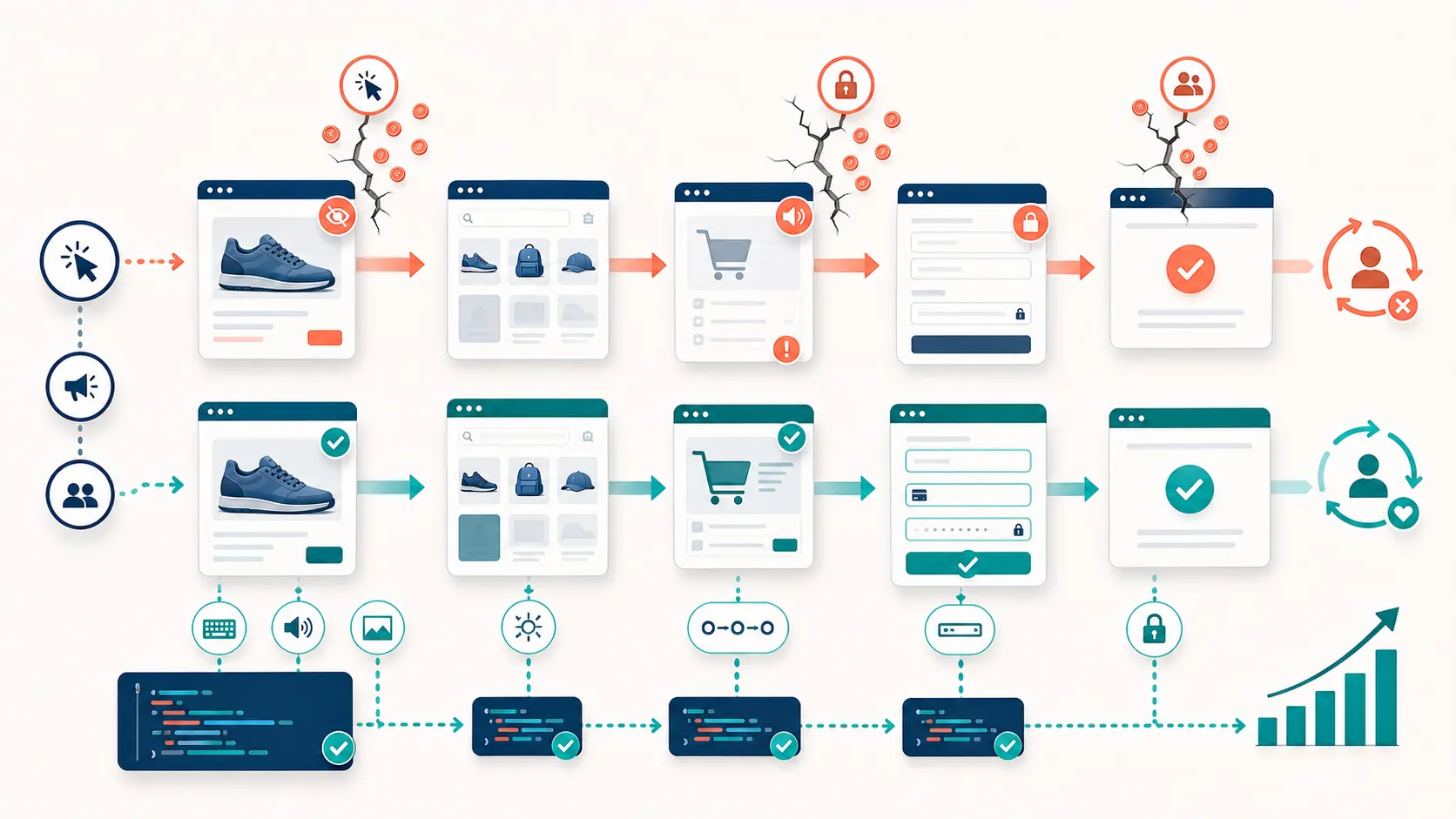
Illustration comparing an inaccessible ecommerce journey that loses traffic, sales and loyalty with an accessible path supporting checkout and repeat growth.

Summary

point-3

Not fixing ecommerce accessibility barriers creates three compounding revenue losses.

Rocket icon

For one global brand, shoppers who used the EnableAll Assist-Bar converted at up to six times the site's average conversion rate.

Code fix icon

Accessibility fixes are also linked to a 9 to 12% lift in organic search visibility, the same signals search engines and AI answer engines reward.

The revenue question

"What's the revenue opportunity here?" is a fair question. It is also only half the conversation. The other half, rarely asked out loud, is: what is inaccessibility already costing you, every day, whether or not you ever think about it?

Both questions have solid numbers behind them. Globally, an estimated 1 in 4 people live with a disability or neurodivergence. In the UK alone that is more than 16 million adults, close to 1 in 5 of the population, and disabled shoppers and their households represent an estimated £274 billion a year in spending power, the so-called Purple Pound. Globally, disabled consumers and their families are estimated to hold around $13 trillion in disposable income. That is the size of the opportunity. It is also, for every store that still has unresolved accessibility barriers, the rough size of what is currently walking away.

This piece lays out both sides properly: the revenue case for installing EnableAll, and the less-discussed cost of not doing it, broken into the three places that revenue actually leaks away. Consider it the fuller answer to the ROI question, not just the sales-pitch half of it.

The case for gain

Start with the upside, because it is measured on live stores, not projected in a spreadsheet.

Antler, the British luggage brand, recorded 3,499 interactions with the EnableAll Assist-Bar in a single month. Shoppers who used those accessibility features converted at up to six times Antler's average site-wide conversion rate. "At Antler, accessibility was never just about compliance," said CEO Kirsty Glenne. "We wanted to create a better experience for every customer visiting our website. What surprised us was the strength of the commercial impact."

EnableAll's own CEO, Imogen Wethered, put the shift plainly: "If customers using accessibility features are converting at materially higher rates, accessibility investment should increasingly be viewed as a growth opportunity as well as a legal requirement."

Antler homepage with the EnableAll Assist-Bar open, beside a hero image of two models with luggage.

Trend Tonic, a jewelry retailer, saw a 46% increase in conversion rate after switching EnableAll on, alongside 114% more items added to cart and 191% more shoppers reaching checkout.

Oakley Home & Gifts cut WCAG errors by 79% and logged over 152,000 customer interactions with accessibility features in its first two months live, a boost that also fed a 3.5x increase in search and AI-assistant visibility.

FaceGym reduced accessibility errors by 98%; its CFO/COO and Head of Franchise said EnableAll "stood out to us for its rich, well-designed feature set and its clear focus on ecommerce use cases," adding that "the mission and story behind the brand gave us real confidence that this is a product built for the long term."

Unhidden founder Victoria Jenkins was more direct still: the Assist-Bar "helped convert customers... made it easier for people to decide whether or not they want to spend their money with us."

Sabatino's VP of Marketing and Creative, Valentina Paci, put it plainly after switching from a previous provider: "We've tried multiple accessibility apps over the years and ran into the same problems: unreliable code fixes, weak backend compliance, toolbars that weren't truly accessible themselves. EnableAll solved all of that."

Underneath those individual results sits a broader pattern EnableAll tracks across its client base: roughly 5.7% of completed sales on live client stores involve a shopper actively using the Assist-Bar, and a further 7% of any given audience relies on assistive technology that only code-level fixes, not a surface widget, actually support.

Published research also links accessibility fixes to organic search gains in the region of 9 to 12%, since much of what improves accessibility (clean structure, proper labelling, properly written alt text) is also what search engines and AI answer engines reward. Put together, that is a credible, three-part case for revenue gained: more shoppers converting, more of the assistive-tech population able to buy at all, and better visibility to be found in the first place.

That is the pitch prospects are used to hearing, and it holds up. But it is not the whole picture, and the pushback usually comes because the whole picture has not been shown.

The other half of the conversation: three places the revenue leaks away

Here is the reframe. Every one of the case studies above describes a store that fixed something. What was happening before they fixed it was not neutral, it was actively costing them money, in three distinct and compounding ways. None of these are hypothetical: they map to independent research and to EnableAll's own commercial-value model, the same one behind every business case report the team builds for prospects.

Screenshot of luxury sportswear sponsored results on Google, the stores hosted on Shopify have the lowest WAVE scores for accessibility

1. Lost ad spend: you already paid for the visit

Every visitor who lands on a store cost something to get there, whether that is a Google or Meta ad, an influencer partnership, or months of SEO investment. That cost is sunk the moment the click happens, regardless of what occurs next.

Independent research puts the number of websites failing basic accessibility standards above 96%. That means the overwhelming majority of paid and organic traffic arriving at any given store includes a meaningful share of disabled or neurodivergent visitors who are about to hit a barrier the business already paid to put them in front of. A missing form label, a colour-contrast failure, a checkout flow that cannot be completed by keyboard alone: none of these announce themselves in a Google Ads dashboard. They just quietly turn a paid click into a paid bounce, indistinguishable in the reporting from any other visitor who left without buying, except that this one never had much chance to buy in the first place.

Look at the screen shot above bidding for luxury women's sportswear. The brands highlighted in maroon are hosted on Shopify, yet they have the lowest WAVE scores compared to the other two. Result? A click you're paying for that can't convert.

This is the least visible of the three leaks, precisely because nothing in standard analytics separates "left because of a barrier" from "left because they weren't interested." The spend is gone either way. The difference is that one of those is fixable, and the fix (code-level remediation) does not require spending more on acquisition, only stopping the waste on the acquisition already paid for.

2. Lost sale: the moment of truth, lost

Assume the visit survives long enough for a shopper to try to buy. If the site is hard to use, a large share of them will not get there. The Click-Away Pound survey, one of the most frequently cited studies in this space, found that 69% of disabled online shoppers will leave a website outright if they find it hard to use because of their disability. A more recent industry survey, AudioEye's 2026 Accessibility Advantage research, found that 62% of business leaders themselves believe their organisation has lost transactions specifically because of accessibility issues. That is not campaigners making the case. That is retail leadership admitting it, in their own research.

The financial scale of this varies by estimate and methodology, but every credible figure lands in the billions: UK retailers alone are estimated to miss out on somewhere between £17 billion and £24 billion a year in online sales because of inaccessible websites, representing an estimated 4.3 million UK shoppers who simply cannot complete a purchase they otherwise intended to make. This is the leak that is easiest to picture, because it happens at the exact moment a business would otherwise recognise a sale: cart open, card details half-entered, and then a barrier the shopper cannot get past.

EnableAll's own commercial model treats this stage conservatively, estimating that around 35% of a store's calculated "lost sales" figure is realistically recoverable once the underlying barriers are fixed, which is itself usually a meaningful number once it is run against a store's actual traffic and average order value.

3. Lost future sales: the customer who never comes back

The first two leaks are bad enough on their own. The third compounds them. Under the same Click-Away Pound research, 83% of disabled shoppers say they restrict their future shopping to sites they already know are accessible. In other words, this is not a one-time bounce. A shopper who hits a barrier once does not typically come back to check whether it has been fixed. They route their future spending, and often their household's spending, somewhere else, permanently.

That matters more than it might first appear, because loyalty economics are steep even before accessibility enters the conversation: the likelihood of a repeat visit climbs from roughly 27% after a first purchase to 49% after a second and over 62% after a third, and a retained customer typically spends 67% more by months 31 to 36 of the relationship than they did in their first six months.

A single bad first experience does not just cost one sale, it forecloses an entire compounding curve of future ones, plus whatever that shopper would otherwise have told friends, family, or the wider disability community, a community that, per EnableAll's own client conversations, talks to itself closely and travels fast on word of a brand that either respected or ignored its needs.

The potential fourth loss

There is a legal and reputational version of this same leak too, worth a brief mention even though it sits outside the three core points. The European Accessibility Act has been enforceable across the EU since 28 June 2025, with penalties running into five and six figures per breach in the most active enforcement markets.

In the US, ecommerce accessibility lawsuits under the ADA topped 4,500 in 2024 alone, typically settling between $20,000 and $100,000, often before remediation costs are even added. BuDhaGirl, a premium jewellery brand, discovered this the hard way: despite already running a competitor's automated overlay, the brand was named in an accessibility-related lawsuit, a clear sign that a surface-level widget had not closed the underlying gaps.

EnableAll's engineering team audited the theme end to end and resolved the root causes with manual, code-level fixes rather than another layer on top. That case is currently in final review with the client before it can be published in full, so treat the specifics as provisional until that sign-off lands, but the pattern it illustrates does not depend on a name being attached: an unresolved barrier is a live liability, not just a missed sale.

Putting the two sides next to each other

Line the two halves up and the pushback starts to look different. The revenue-gain case says: fix the barriers and a business can expect to see more of its existing traffic convert, a meaningful slice of the assistive-tech population able to buy at all, and an organic-search lift on top. The cost-of-inaction case says: for as long as those barriers stay in place, a business is paying to acquire visitors who cannot buy, losing a material share of the sales it should be completing with the visitors who do arrive, and quietly forfeiting a compounding stream of repeat business from the ones who leave and do not come back.

These are not two separate arguments. They are the same set of numbers, read in two directions. The market that is worth £274 billion a year in the UK and an estimated $13 trillion globally does not stop existing because a store has not addressed its barriers, it just spends that money somewhere else. The honest version of "what's the revenue opportunity" is not only "here is what you could gain." It is "here is what is already happening either way, and which side of it you would rather be on."

What this looks like put into practice

None of this requires guessing. The same calculation that produces a headline market-value number for a prospect (traffic × conversion rate × average order value × the share of that audience living with a disability or neurodivergence) also produces a defensible estimate of what an unresolved WCAG score is currently costing, once it is weighted against how severe the barriers actually are. EnableAll builds that specific breakdown, using a prospect's own traffic and order value rather than an industry average, as part of its standard business case process, alongside a live accessibility scan showing exactly which barriers are driving the number up.

Code-Fix addresses the structural side of all three leaks directly by repairing missing labels, poor contrast, broken keyboard navigation and similar issues at the code level, so the fix holds regardless of whether a shopper interacts with anything extra. The Assist-Bar addresses the leaks that depend on a shopper's specific needs in the moment (text-to-speech, contrast and font control, sign language, a reading guide, and more), the layer most directly linked to that 5.7% of completed sales and to the loyalty effect Unhidden and others describe. Auto-Audit and the wider Expert Services team address the risk side, giving a business a documented, dated baseline before a demand letter forces the conversation instead.

Conclusion

For a someone still weighing the question, the fastest way to move past "what's the ROI" as an abstract debate is to run the actual numbers against their own site: their traffic, their average order value, their live WCAG score. That conversation is available at no cost, and EnableAll's Starter tier is free, so a business can see the shift in its own numbers before any procurement conversation is needed at all.

This content is for informational purposes only and does not constitute legal advice. We recommend consulting a qualified legal professional to understand your specific obligations under accessibility laws. Figures describing market size, lost sales and recoverable revenue are estimates based on third-party research and EnableAll's observed client data; they represent a potential opportunity, not a guaranteed outcome.

In just a few clicks.

EnableAll accessibility widget icon
Facegym logo
Unhidden logo
BuDaGirl logo
Sabatino logo
Trend Tonic logo
Antler logo