ASL vs BSL: why sign language is not one language
Accessibility
25 Jun 2026 • 8 mins
ASL vs BSL: why sign language is not one language
Accessibility
25 Jun 2026 • 8 mins
If you’ve thought about Deaf accessibility, you’ve probably thought about subtitles. But when you understand the real difference between ASL and BSL — and why sign language isn’t a signed version of English — a different picture emerges.
It’s a reasonable first step. But it rests on an assumption that quietly undermines the whole effort: that UK/US Deaf people primarily communicate through written English, and that sign language is more or less a visual version of it.
Neither of these things is true.
Sign language is not a signed version of English. It’s a fully independent language — with its own grammar, its own syntax, its own regional dialects, and its own cultural heritage. And there isn’t just one. There are over 320 sign languages used around the world, each developed independently, each distinct from the others.
The sooner we understand that, the sooner we can build digital experiences that genuinely work for Deaf users.
A common misconception — and where it comes from
When hearing people encounter sign language for the first time, the natural assumption is that it mirrors spoken language: English speakers sign in English, French speakers sign in French. But sign languages didn’t develop as visual translations of spoken ones. They grew organically within Deaf communities, shaped by geography, culture, and history — not by the dominant spoken language of the country.
That’s why British Sign Language and American Sign Language are almost entirely different languages, even though both countries share English. A fluent BSL user watching an ASL interpreter will understand very little. These aren’t dialects of the same language. They’re separate languages.
In fact, BSL is more closely related to French Sign Language (LSF) than it is to ASL. This traces back to the early 19th century, when American educator Thomas Hopkins Gallaudet traveled to Europe to establish Deaf education in the US. He brought back French Deaf teacher Laurent Clerc, whose LSF-influenced methods became foundational to ASL. BSL, meanwhile, developed independently in Britain — shaped by its own Deaf schools and communities.
That shared lineage between BSL and LSF — and the divergence from ASL — is one of the most striking examples of how sign languages develop on their own terms, independent of the spoken languages around them.
The scale of these communities
Understanding who uses ASL and BSL puts the real stakes into focus.
UK: 87,000 BSL first-language users (BOA, 2024). 151,000 total BSL community including hearing family, interpreters, and teachers (BOA, 2024).
US: 500,000+ ASL native speakers — the third most-used language in the country, after English and Spanish (CDHH, 2024).
Global: 70 million people worldwide use a form of sign language (UN, 2024). Every day, more than three babies are born Deaf in the US alone (EPI, 2023).
In the UK, 18 million adults report significant hearing difficulties — a number that rises to more than half the population aged 55 and over, and 80% of those over 70 (RNID, 2024). Every day, more than three babies are born Deaf in the US alone (EPI, 2023).
These aren’t niche numbers. They represent a significant portion of the population that too many brands are effectively excluding from their digital experiences — and, in most cases, without realizing it.
What actually makes ASL and BSL different
The differences between ASL and BSL go well beyond vocabulary. These are structurally distinct languages — and understanding the specifics matters if you want to build genuine access.
The manual alphabet
BSL uses a two-handed fingerspelling system. ASL uses one hand. Even at the level of spelling out a word letter by letter, a BSL user watching an ASL signer — or vice versa — won’t be able to follow it.
Grammar and facial expression
Both ASL and BSL use sentence structures that differ from English, and they differ substantially from each other too. Facial expressions in both languages carry grammatical meaning, not just emotion. The raise of an eyebrow marks a yes/no question. Mouth movements indicate degree or intensity. These aren’t decorative — they’re integral to the language.
Regional variation
Like spoken languages, both ASL and BSL have regional dialects. Signs can vary significantly between cities or regions, and communities have their own vocabulary and nuance shaped by local culture and history.
For your brand, the practical takeaway is straightforward: ASL content doesn’t serve BSL users, and BSL content doesn’t serve ASL users. There’s no universal sign language solution. If you want to reach Deaf sign language users, you need to build access for the specific language community you’re serving.
Why subtitles and web copy fall short
Online or on screen text are still the most common accommodation for Deaf users in digital content — and for most teams, they seem like enough. But here’s what they miss.
As our partners at Signapse explain, many Deaf people learn sign language first and English second. Written English proficiency isn’t guaranteed — particularly for people who didn’t have early language exposure, or who weren’t diagnosed early and missed formative periods of language development. For these users, subtitles don’t provide native language access. They provide access through a second language.
There’s also everything that subtitles leave out. Sign language carries tone, emotional nuance, and cultural meaning that written text can’t fully replicate. The facial expression of a signer, the pacing of their hands, the spatial grammar of the language — all of it conveys meaning that subtitles strip away.
In live settings, the problem gets worse. Automatic captions on Google Meet or Zoom are frequently inaccurate, delayed, or both. For a Deaf user relying on them to follow a meeting or a product demo, that doesn’t just cause frustration — it can mean missing context, misunderstanding what’s been agreed, or feeling shut out of a conversation that directly affects them.
Subtitles have their place. But for Deaf users whose first language is BSL or ASL, they’re at best a partial solution — and at worst, a false sense of inclusion.
What genuine sign language accessibility looks like
Building real access for Deaf sign language users means treating sign language as the primary medium — not an afterthought.
That starts with content in the user’s language. Rather than relying on auto-captions, genuinely accessible content includes BSL or ASL interpretation delivered natively — through human interpreters or, increasingly, through AI-powered translation.
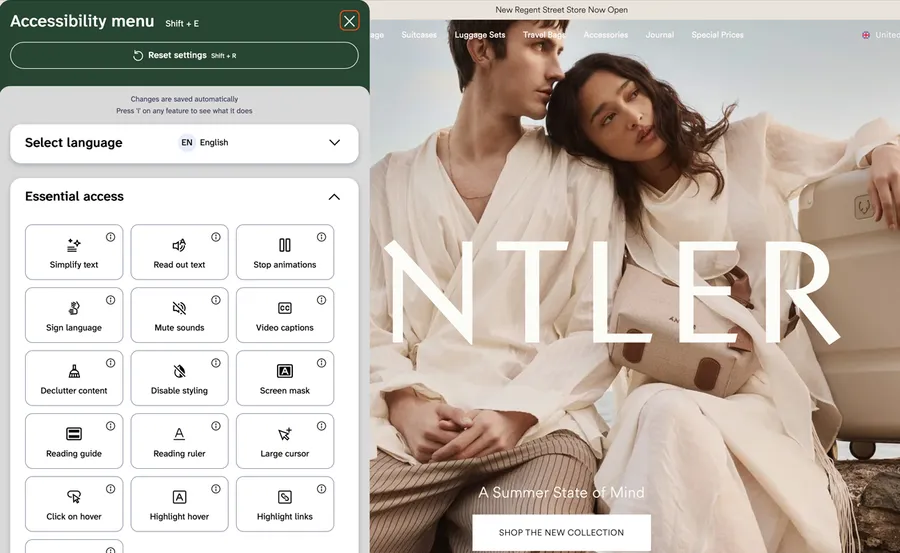
And this demand is already showing up in real customer data. Antler — the globally recognized premium luggage brand and an EnableAll customer — records 5.8 sign language activations per day across their US, UK and global digital estate. Those aren’t power users or outliers. They’re everyday shoppers who need this access to engage with the brand.
This is where our partners at Signapse are doing important work. Signapse builds AI-powered tools that translate spoken or written English into British Sign Language and American Sign Language — quickly, accurately, and with cultural respect. Their approach centers sign language as a first language for millions of Deaf users, rather than treating it as a subtitling workaround. Their products help businesses build sign language access into content, communications, and customer-facing infrastructure, at scale.
For brands operating across both the UK and the US, the distinction between BSL and ASL is not an edge case. It’s a core requirement — and the content needs to be built separately for each audience.
What this means for your website or digital store
Antler is a useful illustration of what this challenge looks like in practice. They’re a globally recognized premium luggage brand, operating both antler.co.uk for UK customers and antler.com for US customers. Those two audiences don’t share a sign language any more than they share a dialect. If Antler wants to serve Deaf customers in the UK, that means BSL. To serve Deaf customers in the US, that means ASL. There’s no shortcut that covers both.
That’s increasingly the reality for any brand with a global digital presence. The same product, the same website, the same checkout flow — but fundamentally different language needs depending on where your customers are.
And those language needs don't stop at sign language. The same logic extends beyond sign language. A store that's visually accessible in Japan but still sells only in English hasn't actually made itself accessible to Japanese customers, it's applied one market's standard to a different market's audience, the same mismatch this article describes between ASL and BSL. Genuine accessibility for a global storefront means both: a structurally accessible site, and content that reads natively in the language of the market you're serving. Tools like Lara Translate handle the second part, producing storefront and product content that reads as native to each market rather than a generic translation applied everywhere.
For ecommerce brands more broadly, the implications are practical. Product videos that rely on audio alone — even with auto-captions — are inaccessible to significant parts of the Deaf community. Checkout flows with audio instructions, customer support via phone, live events with inadequate captioning: each of these creates a barrier at exactly the moment you’re trying to build a relationship with a customer.
The legal picture reinforces this. The European Accessibility Act came into force in June 2025, the UK Equality Act establishes duties around disability access, and the ADA continues to drive accessibility requirements in the US. Sign language access is increasingly part of what “accessible” means in a legally meaningful sense.
The good news: the tools now exist to close these gaps. AI-powered sign language translation, combined with strong baseline accessibility on your underlying digital experience, means there’s no longer a technical barrier to building genuine access for Deaf communities — at scale, and without compromising your brand.
Closing thoughts
If your approach to Deaf accessibility begins and ends with subtitles, the communities that use BSL or ASL as their first language are likely still being left behind.
The differences between ASL and BSL aren’t minor variations on the same theme. They’re different languages, with different grammars, different alphabets, different histories, and different cultural contexts. Serving these communities well starts with understanding that — and then building the access they actually need.
We’re proud to work alongside partners like Signapse who are making sign language access possible at scale. And we’re proud to work with brands like Antler who are proving that accessibility and a premium digital experience aren’t in conflict — they’re complementary.
Together, the aim is the same: a digital world that doesn’t ask Deaf users to work around it.
Want to build genuine accessibility for Deaf users? Find out how EnableAll and Signapse are working together to make digital experiences accessible for BSL and ASL communities — and how brands like Antler are already seeing results. Visit enableall.com/solutions
Sources
BOA (2024). British Sign Language statistics. British Deaf Association.
CDHH (2024). American Sign Language usage statistics. Commission for the Deaf, Hard of Hearing, and DeafBlind.
RNID (2024). Hearing loss statistics for the UK. Royal National Institute for Deaf People.
UN (2024). Sign languages — global usage. United Nations.
EPI (2023). Children born Deaf statistics. Early Hearing Detection and Intervention Program.
NIH (2024). Hearing loss in children. National Institute on Deafness and Other Communication Disorders.
Signapse (2024). Why subtitles miss the mark. Signapse.
Antler × EnableAll (April 2026). Accessibility case study. EnableAll.