The deaf tech stack: 11 companies changing what accessibility looks like in 2026
Accessibility
06 May 2026 • 9 mins
The deaf tech stack: 11 companies changing what accessibility looks like in 2026
Accessibility
06 May 2026 • 9 mins


4th to 10th May 2026 is Deaf Awareness Week in the UK — a good moment to take stock of where the technology has got to.
A decade ago, a list like this wouldn't have existed. Accessibility technology for deaf and hard-of-hearing people meant a narrow band of specialist hardware: flashing doorbells, vibrating alarm clocks, bulky relay phones. Useful, but rarely designed with ambition, and almost never designed to cross over into the mainstream.
That's changed. What the following 11 companies make clear is that deaf accessibility is now a genuine product and commercial moment, not a compliance exercise. The range is striking: consumer giants like Meta embedding live captions into fashion eyewear; VC-backed startups like Nagish rethinking the phone call from scratch; Deaf-founded businesses like GoSign.ai building from lived experience; a university lab open-sourcing a smartwatch sound detector. They're approaching the same problem from completely different angles, and the quality of what they're building is catching up with what hearing users have always taken for granted.
Whether you're a product team mapping the landscape, a procurement lead evaluating assistive tech, or tracking where the sector is heading, these are the companies worth knowing about.
Sign language & communication
EnableAll
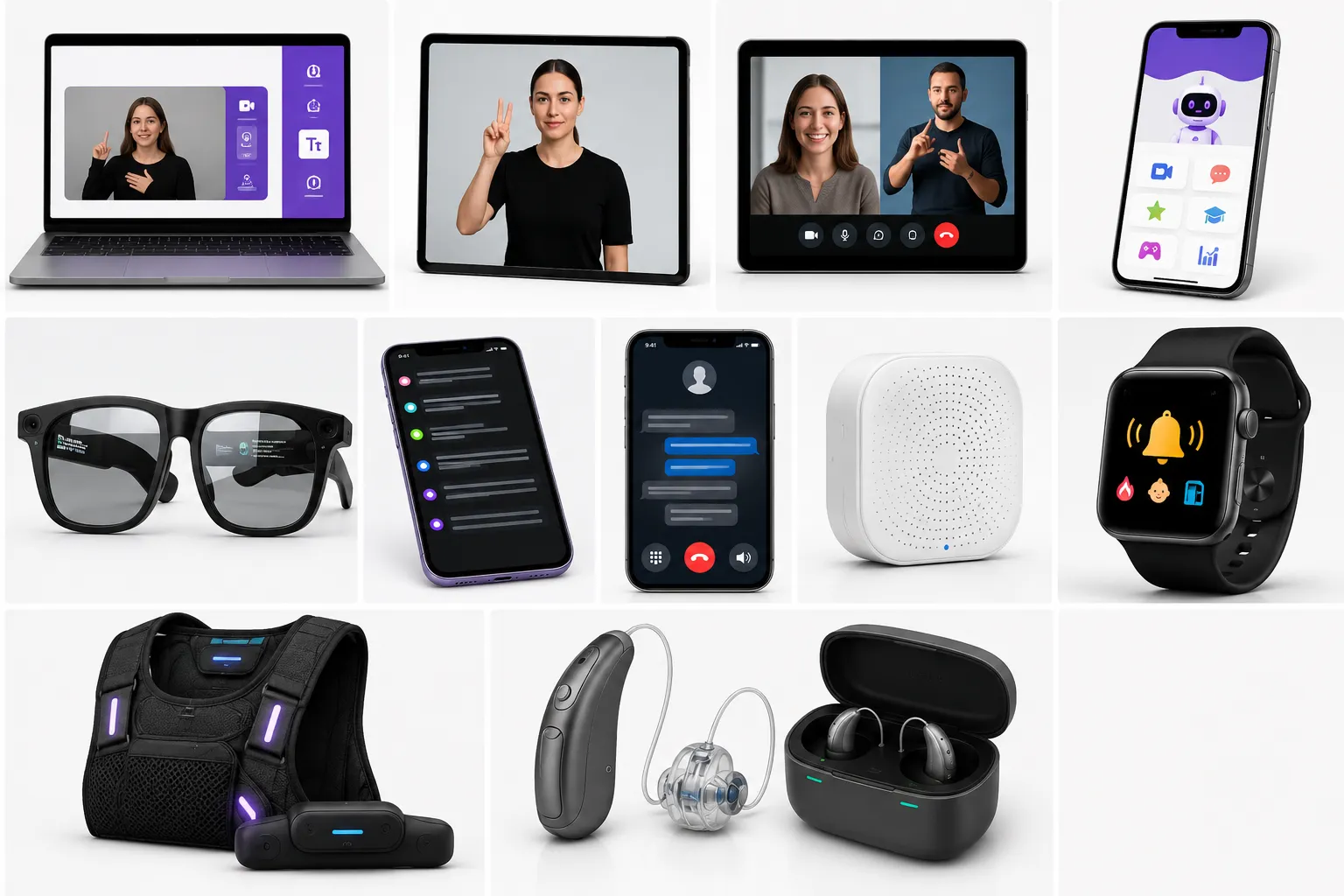
For a deaf customer browsing an online shop, even a well-designed website can feel like it was built for someone else. Product descriptions, promotional videos, policy pages — all written for a hearing audience. EnableAll is a web accessibility platform that gives retailers a toolbar on their site, letting deaf customers click on any text or video content to see it instantly translated into sign language. It takes minutes to install and requires no changes to the underlying site. The software is already live on WeAreAsha.com, the resort wear brand from Tasha Ghouri, where customers use the sign language feature every single day. 🔗 enableall.com
Signapse
Sign language is the first language of most deaf people, which means written English on a website or in a video is effectively a second language. Signapse is an AI tool that converts written text and video content into photorealistic sign language, using a digital signer that is built to look and move like a real human interpreter rather than a robotic avatar. Brands can use it to make their websites, transport announcements, broadcast content, and marketing videos accessible to deaf audiences at a fraction of the cost of hiring human interpreters for every piece of content. It is already in use across public transport networks and ecommerce, and is expanding into live streaming and broadcast. 🔗 signapse.ai
SignVideo
When a deaf person needs to speak to their bank, their GP, or a customer service team, they often face a problem: the person on the other end doesn't know sign language. SignVideo solves this by connecting deaf BSL users with qualified human interpreters via a video call, in real time, from any device. Think of it as a three-way call where the interpreter bridges the conversation instantly. It is used by the NHS, major banks, local councils, and government departments across the UK, meaning a deaf person can access services that most hearing people take for granted, from a phone or laptop, wherever they are. 🔗 signvideo.co.uk
GoSign.ai
Most AI tools are built by hearing people, for hearing people. GoSign.ai is different: a Deaf-led startup that is building a suite of AI tools specifically for the deaf community. Its products include sign language video generation for brands wanting to communicate with deaf audiences, subtitle tools, gamified learning apps, and a paid data contribution programme where deaf users earn money by helping train the AI models that power the next generation of accessible technology. The company puts deaf people at both ends of the product: as the audience it serves and as the community that builds it. 🔗 gosign.ai
Captioning & calling
XRAI Glass
Imagine being able to see a live transcript of every conversation happening around you, floating in your field of vision as the words are spoken. That is what XRAI Glass does. Designed specifically for deaf and hard-of-hearing people, these smart glasses use AI to generate real-time captions in over 140 languages, displayed directly on the lens. Whether it's a meeting at work, a conversation at a party, or an announcement at a train station, wearers can follow what's being said without relying on lip reading or asking people to repeat themselves. Life, literally subtitled. 🔗 xrai.glass
Ava
Group conversations are one of the hardest situations for deaf and hard-of-hearing people to navigate: multiple voices, fast pace, no way to follow who said what. Ava is a captioning app that transcribes conversations in real time and colour-codes each speaker so users can follow the flow of a discussion as it happens. It works in meetings, classrooms, medical appointments, and social settings. A deaf person can open the app at a hospital appointment and read exactly what their consultant is saying, or use it in a team meeting to keep up without having to ask colleagues to slow down or repeat themselves. 🔗 ava.me
Nagish
Making a phone call is something most people do dozens of times a week without thinking. For deaf and hard-of-hearing people, it has historically meant using a relay service where an operator listens in and types what the other person says — functional, but not private. Nagish replaces all of that with an AI-powered app that captions both sides of a phone call in real time, entirely automatically, with no third party involved. It was the first AI-powered service to receive FCC IP Relay certification in the US, and it works on any standard phone call, making it useful anywhere from booking a restaurant to calling a doctor. 🔗 nagish.com
Smart home alerting
Earzz
At home, deaf and hard-of-hearing people can miss sounds that most people rely on without realising: a smoke alarm going off in another room, a baby crying, a doorbell, a dog barking. Earzz is a smart monitor that sits in a room and uses AI to listen for these sounds, identify them, and immediately send a visual or vibration alert to the user's phone, tablet, or smartwatch. It covers over 30 different sounds, learns to tell them apart accurately, and processes everything on the device itself so no audio is ever stored or sent to the cloud. It's a small device with a straightforward job: making sure nothing important goes unheard. 🔗 earzz.com
SoundWatch
Developed by researchers at the University of Washington, SoundWatch takes a similar idea and puts it on the wrist. The open-source app runs on a smartwatch and uses machine learning to detect sounds in the wearer's environment, from fire alarms and sirens to doorbells and speech. When it detects something, it sends a vibration and a label to the watch face so the wearer knows what the sound was. As an open-source academic project it is free to use, and for deaf users who already wear a smartwatch it adds a layer of environmental awareness that requires no extra device at all. 🔗 makeabilitylab.cs.washington.edu/project/soundwatch
Wearables & haptics
Tactus Music
Music has always been described as something you hear, but for deaf and hard-of-hearing people, it can also be something you feel. Tactus makes wearable technology developed with and for the deaf community that translates music into physical vibration and sensation across the body, letting wearers experience rhythm, bass, and melody through touch. Whether at a live concert, a festival, a performance, or at home, Tactus gives deaf users a way to be genuinely inside the music rather than on the outside of an experience designed for others. 🔗 tactusmusic.com
Hearing aids
Starkey Omega AI
Hearing aids have historically struggled in the situations where people need them most: noisy restaurants, crowded rooms, busy offices where voices come from every direction. Starkey's Omega AI tackles this with DNN 360, described as the first deep neural network-powered directional system in a hearing aid, which processes sound from all directions simultaneously and adapts in real time to whatever environment the wearer is in. Independent testing places it among the top performers for speech clarity in difficult listening conditions, with results suggesting up to 28% improved speech understanding compared to previous technology. For anyone with hearing loss who has given up on following conversations in a noisy room, it represents a meaningful step forward. 🔗 starkey.com/hearing-aids/omega-artificial-intelligence-hearing-aids