The Web Content Accessibility Guidelines (WCAG): What ecommerce brands need to know
WCAG
09 Jun 2026 • 11 mins
The Web Content Accessibility Guidelines (WCAG): What ecommerce brands need to know
WCAG
09 Jun 2026 • 11 mins


What is WCAG?
The Web Content Accessibility Guidelines (WCAG) are global standards designed to make websites usable for everyone, including people with disabilities. They’re created by the World Wide Web Consortium (W3C) and are regularly updated as technology evolves.
Think of WCAG as a checklist that most laws refer to when they require your website to be accessible. By following these standards, you’re not only meeting domestic legal requirements, such as the Americans with Disabilities Act (ADA) or the European Accessibility Act (EAA), but also tapping into a market of 1.3 billion people worldwide.
Why WCAG matters
An estimated 1.3 billion people, about 16% of the global population, live with a disability such as mobility issues, sight or hearing impairments, or cognitive and neurodiversity challenges. In the EU, it’s around 87 million people. In the US, it’s around 25% of the population (70 million adults).
The World Health Organization (WHO) states that disabilities are on the rise, partly due to population aging and an increase in the prevalence of non-communicable (non-contagious) diseases.
One in five of us is neurodivergent. Common types of neurodivergence include: Autism Spectrum Disorder (ASD), Attention-Deficit/Hyperactivity Disorder (ADHD), Dyslexia, Dyspraxia (Developmental Coordination Disorder), and Dyscalculia.
Why does WCAG matter for your online store?
Accessibility isn’t just about ticking compliance boxes. It’s about ensuring everyone can browse, shop, and make purchases with ease.
Visual accessibility: Shoppers with low vision need clear color contrast and alt text for images.
Hearing accessibility: Captions help deaf and hard-of-hearing users enjoy your videos.
Neurodivergence: Consistent layouts and simple navigation help users with dyslexia, ADHD, or memory challenges complete purchases.
Mobility: Keyboard navigation ensures customers who can’t use a mouse can still shop your store.
When you get this right, you’re not only doing the right thing, but also unlocking new sales, building loyalty, and strengthening your brand reputation.
The POUR principles: Accessibility made simple
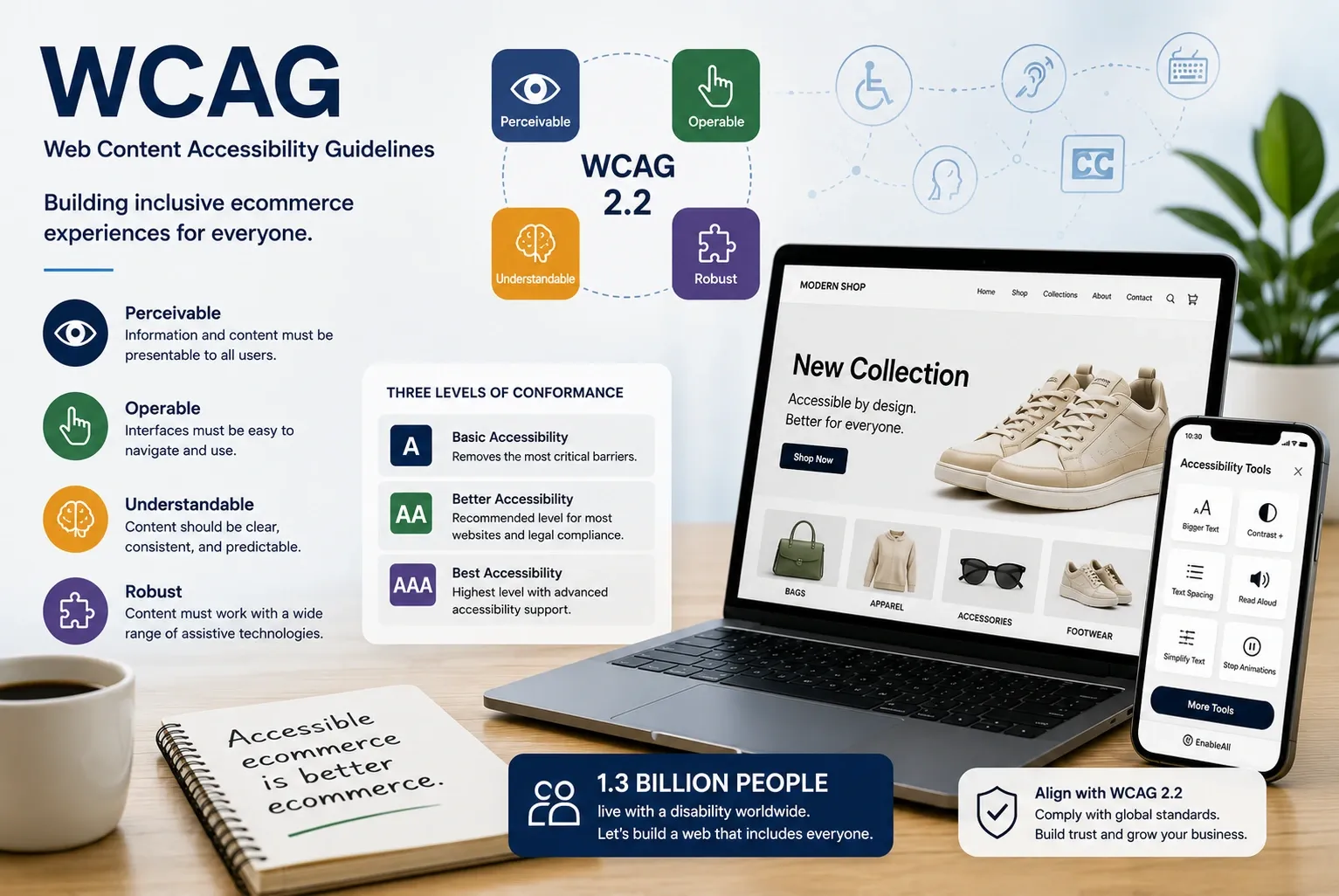
WCAG 2.2 AA is currently regarded as the safest benchmark for ecommerce accessibility. WCAG standards are built around four easy-to-remember principles, often called POUR:
- Perceivable (Information should be presented in ways that all users can access, such as by providing alternative text for images)
- Operable (Interfaces should be easy to navigate when using a variety of devices and assistive technologies).
- Understandable (Content should be clear and predictable).
- Robust (Websites and digital tools should work with a wide range of assistive technologies).
For ecommerce merchants, this typically includes:
- Image alt text
- Keyboard accessibility
- Form labels
- Color contrast
- Clear heading structures
- Screen reader compatibility
- Accessible checkout experiences
Three levels of WCAG conformance
There are three levels of WCAG conformance to consider, namely A, AA, and AAA. To achieve each level, you must meet the requirements of the previous level before making additional improvements.
In short:
- Level A helps people access your site.
- Level AA helps them use it comfortably.
- Level AAA makes it even more usable for everyone.
Most global standards and legislation require Level AA compliance, but aiming higher makes your store even more welcoming.
Why ecommerce websites struggle with accessibility
Ecommerce websites are among the most difficult digital experiences to make fully accessible because they combine:
- Dynamic interfaces
- Frequent content changes
- Third-party apps
- Complex checkout systems
- Mobile interactions
- Promotional campaigns
Even well-designed Shopify stores can develop accessibility issues over time through app installations, theme customizations, popups, product updates, and marketing integrations.
Some of the most common ecommerce accessibility barriers include:
- Inaccessible filters and faceted search
- Keyboard traps in popups
- Poorly labeled checkout forms
- Image-only buttons
- Inaccessible product galleries
- Auto-rotating carousels
- Low-contrast promotional banners
This is why accessibility should be treated as an ongoing operational process rather than a one-time compliance exercise.
What’s new in WCAG 2.2?
WCAG 2.2, published in 2024, introduced new success criteria to enhance support for users with cognitive and mobility needs. For Shopify and other online store owners, that means improvements like:
- Easier-to-use forms and checkout flows.
- Better support for touch targets (making buttons easier to click or tap).
- Stronger focus on users with ADHD, memory challenges, and other neurodivergent experiences.
By striving for WCAG 2.2 today, you won’t just be compliant; you’ll future-proof your store for WCAG 3.0, expected in 2027, which will encourage even more inclusive practices.
What WCAG 3.0 will mean for online retailers?
WCAG 3.0 will raise the standard for global accessibility, and businesses that start preparing now will stay ahead of the curve. WCAG 3.0 isn’t just a minor update. It’ll be a major rethink designed to make accessibility:
- Clearer : Easier to understand for non-technical teams.
- More flexible : Better adapted to modern digital products (apps, voice tools, AI interfaces).
More inclusive: Stronger support for people with cognitive and learning disabilities, not just sensory and physical ones.
Instead of relying solely on pass/fail checkboxes, WCAG 3.0 will introduce a scoring system that promotes ongoing improvement, recognizing that accessibility is a continuous journey rather than a one-off task.
Why prepare now?
Accessibility isn’t just about avoiding legal issues; it’s about remaining competitive. By the time WCAG 3.0 launches, expectations will have evolved. Customers, regulators, and even search engines will expect companies to do more.
If you’re already building towards WCAG 2.2 AA today, you’ll be in a much stronger position to embrace WCAG 3.0 tomorrow.
Think of it this way: preparing now means fewer rushed updates, fewer risks, and a smoother customer experience.
Steps to future-proof your online store
Here are three smart moves to start preparing for WCAG 3.0:
- Aim higher than the minimum. Most worldwide accessibility laws today require compliance with WCAG 2.1 or 2.2 AA. But if you push towards AAA standards, such as aiming for a 7:1 color contrast ratio for text or offering simple, clear language throughout, you’ll already align with where WCAG 3.0 is heading.
- Focus on cognitive accessibility. WCAG 3.0 will place more emphasis on users with ADHD, dyslexia, autism, and other neurodivergent experiences. Start now by simplifying layouts, avoiding time-limited tasks, and giving users control over distractions like autoplaying videos.
- Test with real people. Tools and checklists are essential, but nothing beats feedback from actual users, including people with disabilities. This practice will become even more valuable under WCAG 3.0’s flexible, user-centred approach.
How should ecommerce merchants comply?
Accessibility should be integrated into ecommerce operations continuously rather than treated as a one-time project.
Recommended steps include:
1. Audit your website accessibility. Evaluate issues affecting:
- Keyboard navigation
- Screen readers
- Forms
- Ecommerce flows
- Contrast ratios
- Mobile usability
2. Improve accessibility at the code level
Many accessibility issues exist within HTML structure, ARIA labels, forms, navigation, and semantic markups. Code-level remediation provides stronger accessibility support than surface-level adjustments alone.
3. Test accessibility regularly
Ecommerce stores constantly change product listings, apps, campaigns, themes, and promotions, so accessibility should be monitored continuously.
4. Include manual accessibility review
Automated testing alone cannot detect every accessibility issue. Human testing remains essential for identifying usability barriers and compatibility issues with assistive technology.
5. Publish an accessibility statement
An accessibility statement helps demonstrate transparency, commitment, and ongoing compliance efforts.
How can EnableAll help?
EnableAll is an accessibility platform built specifically for ecommerce environments such as Shopify stores. Rather than relying on overlay-based approaches, EnableAll focuses on automatic code-level accessibility improvements.
EnableAll helps merchants:
- Improve WCAG alignment
- Strengthen accessibility support
- Reduce developer workload
- Avoid heavy scripts that can impact performance
Features include:
- Automatic accessibility code-fix technology
- Assist-Bar accessibility tools
- Ecommerce-trained AI
- Accessibility scanning and monitoring
- Alt text support
- Keyboard and screen reader enhancements
- Accessibility statement support
EnableAll is designed to help ecommerce brands:
- Reduce accessibility barriers
- Improve the customer experience
- Support WCAG 2.2 efforts
- Improve accessibility without redesigning their store
Like all accessibility tools, EnableAll does not guarantee full legal compliance on its own, as accessibility requires ongoing monitoring and human review.
Frequently Asked Questions about WCAG
What does WCAG stand for?
WCAG stands for: Web Content Accessibility Guidelines. These are international accessibility standards created by the World Wide Web Consortium (W3C) to help make websites, apps, and digital services more accessible to people with disabilities.
Is WCAG a law?
No. WCAG itself is not legislation. However, WCAG is widely used as the technical standard underpinning accessibility laws and regulations around the world, including:
- The Americans with Disabilities Act (ADA)
- The European Accessibility Act (EAA)
- EN 301 549
- The Accessibility for Ontarians with Disabilities Act (AODA)
- Israel Standard 5568
- JIS X 8341 in Japan
- In practice, many organizations use WCAG to demonstrate accessibility compliance efforts.
Which WCAG version should ecommerce merchants follow?
WCAG 2.2 AA is increasingly viewed as the recommended benchmark for ecommerce accessibility. Although many laws still formally reference WCAG 2.1 AA or even WCAG 2.0 AA, businesses adopting WCAG 2.2 AA are generally better positioned for:
- Future compliance
- Improved usability
- Stronger accessibility coverage
- Evolving customer expectations
Does WCAG apply to Shopify stores?
Yes. Shopify stores may be expected to meet WCAG accessibility standards depending on:
- Where they operate
- Which customers they serve
- Applicable accessibility laws
Even where WCAG is not directly mandated by law, accessible ecommerce experiences are increasingly viewed as best practice.
What are the most common WCAG accessibility problems on ecommerce websites?
Common accessibility issues include:
- Missing image alt text
- Inaccessible forms
- Poor keyboard navigation
- Low color contrast
- Inaccessible checkout experiences
- Improper heading structures
- Missing button labels
- Inaccessible popups and overlays
Ecommerce websites are particularly complex because stores constantly change due to promotions, apps, theme updates, product launches, and third-party integrations.
Can accessibility overlays make a website WCAG compliant?
No. Accessibility overlays and widgets may help improve some user experiences, but no overlay can guarantee full WCAG compliance on its own. Many accessibility issues exist at the code, structural, content, and checkout functionality levels. This is why many accessibility experts recommend combining code-level remediation, accessibility testing, ongoing monitoring, and manual review, rather than relying solely on overlays.
Does WCAG help SEO?
Yes. Accessible websites often support cleaner code, stronger semantic structure, better usability, improved crawlability, and improved mobile experiences. These improvements can indirectly support organic visibility, user engagement, and conversion performance. Accessibility and SEO increasingly overlap because both prioritize usable, structured digital experiences.
Is WCAG compliance a one-time project?
No. Accessibility is an ongoing process because ecommerce websites constantly evolve through new products, theme changes, app installations, campaigns, and checkout updates. Maintaining accessibility requires continuous monitoring, regular testing, and ongoing improvements.
Will WCAG 3.0 replace WCAG 2.2?
Eventually, yes — but not immediately. WCAG 3.0 is still under development and is expected to introduce a more flexible scoring system, stronger cognitive accessibility guidance, and broader accessibility evaluation models. However, WCAG 2.2 AA remains the practical ecommerce benchmark today.
Where to Learn More About WCAG
Official resources
Related accessibility resources
EnableAll resources
Final thoughts
WCAG has become the global foundation for digital accessibility, but for online retailers, it represents much more than a technical standard. Modern ecommerce depends on creating shopping experiences that work for as many people as possible, across every device, interaction, and customer journey. Accessibility is increasingly part of that expectation. For Shopify and other online merchants, improving accessibility can support stronger usability, better mobile experiences, improved conversion opportunities, broader customer reach, and greater customer trust.
WCAG also provides something many businesses struggle with in accessibility - a practical framework for continuous improvement. That matters because accessibility is not static. Ecommerce stores constantly evolve through new products, changing themes, apps, campaigns, checkout updates, and customer expectations.
The businesses that approach accessibility as part of long-term ecommerce quality — rather than simply legal compliance — are likely to be best positioned for the future. As global accessibility standards continue evolving toward WCAG 3.0 and beyond, merchants that invest early in accessibility maturity will generally face fewer remediation challenges, lower long-term risk, stronger customer experiences, and greater international readiness.
In ecommerce, accessibility is increasingly becoming part of what defines a high-quality digital experience.
This web page is provided for informational purposes only and should not be considered legal advice. Please consult with a legal professional before taking any action.