What happens when your store receives an accessibility claim
Compliance
11 Sep 2026 • 8 minutes
What happens when your store receives an accessibility claim
Compliance
11 Sep 2026 • 8 minutes
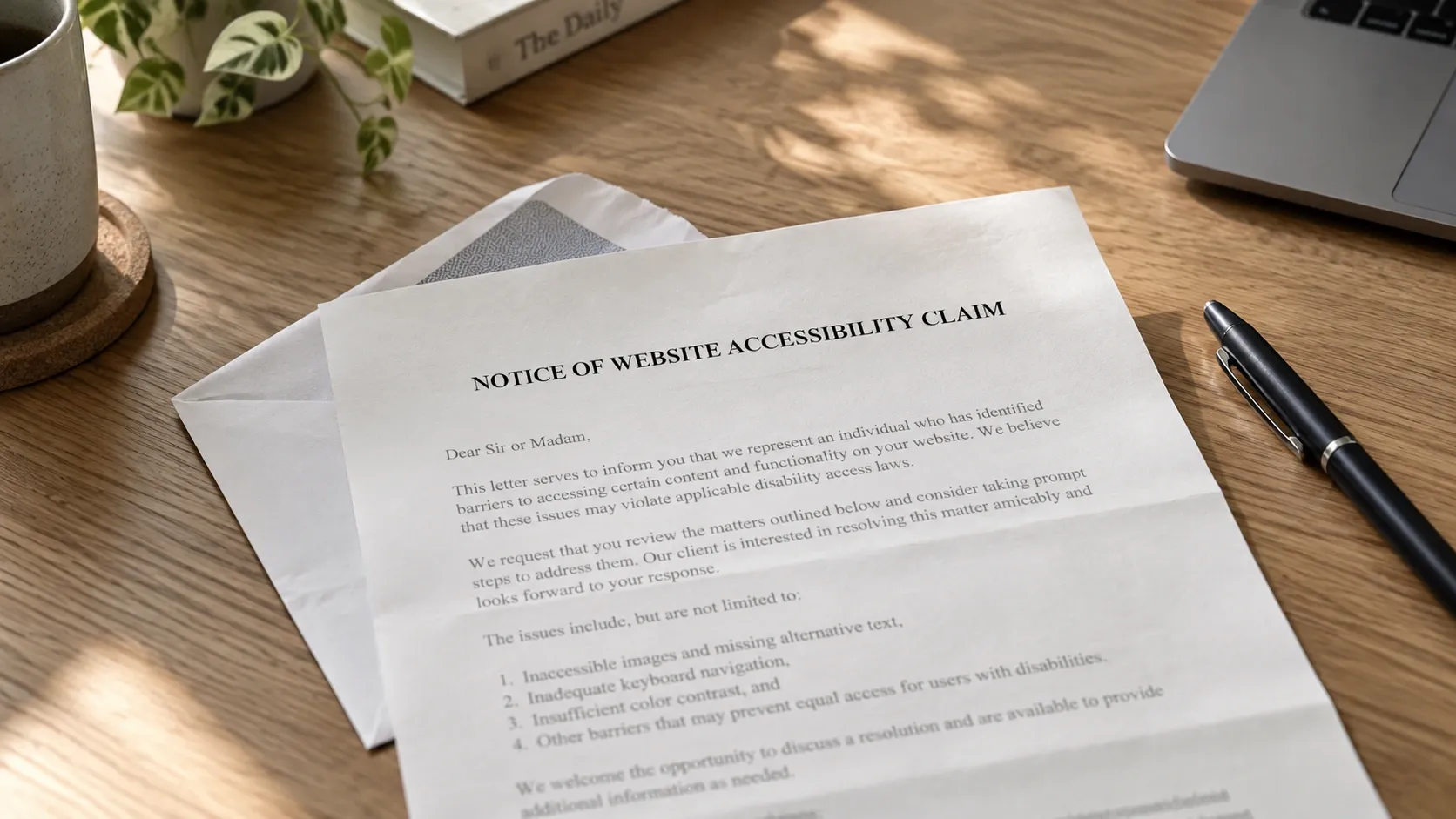
The arrival
It comes out of the blue. A letter arrives from a law firm you have never heard of, alleging accessibility barriers on your website. It lists numbered requirements from the Web Content Accessibility Guidelines, or WCAG, and names specific pages: your collection grid, product page, cart and checkout. It gives you a deadline to respond.
The document reads like a bill with a deadline attached.
For ecommerce brands selling into the US, this is a growing concern. UsableNet projects roughly 6,176 digital accessibility lawsuits in 2026, close to 20% above 2025. Ecommerce accounted for 79% of filings in the first half of 2026.
This article explains who sends these letters, what to do first, and the main options for responding. It also explains why resolving a claim and fixing the underlying accessibility barriers need to go together.
Disclaimer: This article provides general information about how these cases tend to run. It does not constitute legal advice. Talk to a qualified attorney about your own situation.
Who sends these letters
In the first quarter of 2026, 1,037 lawsuits concerning website accessibility under the Americans with Disabilities Act, or ADA, were filed in the US. Those cases were concentrated among a small number of plaintiffs and law firms.
Twenty-seven plaintiffs filed just over half the cases. Ten law firms accounted for about 83% of filings. This concentration helps explain why letters sent to different stores can look so similar.
Automated scans can help identify common barriers, including missing image descriptions, unlabeled form fields and low text contrast. Other problems become apparent when someone tries to use the store with a keyboard or screen reader, which reads page content aloud.
The useful point for a store owner is that these are problems you can address. Finding and fixing them improves the experience for customers and reduces the barriers that could support a claim.
Why Shopify stores feature so often
Shopify stores accounted for 459 of those Q1 filings, about 44%. Size offered little protection: 64% of the companies sued had annual revenue below $25 million.
Shared code helps explain the pattern. A theme contains page structures and controls that recur across stores using it. Apps add more shared components: review widgets, size guides, cart drawers, cookie banners and subscription selectors. A defect in a widely used component can therefore appear across many stores.
Common examples include:
Color or size swatches that a screen reader cannot identify.
Quantity controls whose plus and minus buttons have no readable labels.
Cart drawers that open while keyboard navigation continues through the page behind them.
Carousels that advance automatically without a pause control.
Discount fields whose instructions disappear as soon as the customer starts typing.
Cookie banners that leave keyboard users unable to reach the rest of the page.
These are familiar parts of the buying journey. When they fail, a customer may be unable to choose a product, change a quantity or complete a purchase. That makes their impact straightforward to describe in a complaint.
What to do in the first two days
Start by identifying what you have received. A demand letter and a court complaint are different documents, with different response requirements. Ask your attorney to confirm the applicable dates before relying on a general timeline.
Three people need to hear about it promptly:
Your attorney. Look for experience in website cases under Title III of the ADA, the part of the law commonly cited in these claims.
Your insurance broker. Ask whether any policy may respond and what notification deadlines apply.
Your developer or agency. They will need to assess the cited barriers and scope the fixes while counsel handles the legal response.
Discuss preservation with your attorney before changing the cited pages. This may include taking a full site backup, saving source code and capturing dated screenshots. The aim is to record the site's condition before work begins, in the sequence your case requires.
Avoid replying directly to the plaintiff's firm before speaking to counsel. Early correspondence can affect how your attorney handles the response.
If you received a demand letter
The letter may request a response within 30 to 60 days. Have counsel confirm what it requires and how to respond. There is no single timetable that applies to every letter.
If you were served with a federal complaint
A response is generally due within 21 days of service, although the applicable deadline can vary. Have counsel confirm the date and whether an answer or another response is appropriate.
Resolution takes longer than the initial response. The settlement routes below may run from 30 to 180 days; a defended case may take six to eighteen months.
The three paths and what they cost
The figures below are indicative estimates, not quotes. They cover different types of spending, so compare the full expected cost with counsel before choosing a route. All amounts are in US dollars.
Settle without fixes. Indicative timeline: 30 to 90 days. Estimated costs: $5,000 to $20,000 settlement, plus $3,000 to $8,000 legal fees. Effect on repeat exposure: existing barriers remain.
Defend the case. Indicative timeline: 6 to 18 months. Estimated costs: $15,000 to $75,000 legal fees, with settlement and remediation, if needed, additional. Effect on repeat exposure: depends on whether barriers are fixed.
Settle with code fixes. Indicative timeline: 90 to 180 days. Estimated costs: $500 to $10,000 settlement, plus remediation, with legal fees to confirm separately. Effect on repeat exposure: addresses the barriers behind the claim.
Settling quickly can look like the simplest commercial decision: sign, pay and let the team get back to trading. But if the barriers remain, the settlement leaves the store exposed to another claim.
Defending a case may be appropriate, depending on the facts and legal issues. It does not itself improve accessibility. Legal fees may therefore sit alongside the cost of fixing the store.
Settlement can also involve more than a payment. Terms may include a commitment to WCAG 2.1 Level AA, a commonly cited accessibility standard, along with a remediation deadline, oversight and ongoing reporting. Ask counsel to explain both the immediate payment and the work you would be committing to.
Why another claim can become the larger cost
In 2025, 46% of federal digital accessibility cases involved repeat defendants. That makes the condition of your store after the first claim an important part of the decision.
A settlement resolves a particular dispute. It does not, by itself, remove the barriers that led to it. If those barriers remain, another customer may encounter them and another claim may follow.
Installing an accessibility widget does not necessarily prevent this. In Q1 2026, 265 of the sites sued had one installed, about a quarter of all filings in that period.
An overlay is software that adds accessibility adjustments in the browser. Those adjustments do not necessarily correct the underlying theme or app code, and barriers can remain. The practical question is whether customers can use the site successfully, including with a keyboard or screen reader.
What an ongoing accessibility program involves
For Shopify stores, our approach combines code remediation, ongoing checks and optional controls for users. Each has a different role.
Fix the underlying code
Correct image descriptions, form labels, button names, page structure, keyboard behavior and contrast in the theme and its components. This is the role of Code-Fix: addressing accessibility problems at code level across a Shopify store's theme and surrounding apps.
Check the result against the tasks customers need to complete. Can they select a variant, adjust a quantity, dismiss a banner and finish checkout? An automated scan is useful, but those journeys also need testing with a keyboard and assistive technology.
Give users additional controls
A toolbar can complement an accessible build by letting users adjust text size, spacing, contrast and reading support. Assist-Bar provides these options, including OpenDyslexic and Mencap fonts and Signapse sign language.
This is a different role from relying on a widget to correct the site. User controls add choice; the underlying store still needs to work accessibly.
Keep checking as the store changes
Themes update, apps update and your team publishes new pages. Those changes can introduce new barriers. A one-time audit describes the store you had in March.
Continuous scanning helps identify new issues. Combine it with checks of the buying journey after changes to important pages or components.
Publish an accessibility statement
Explain what has been fixed, what is still in progress and how customers can report a barrier. Keep the statement aligned with your remediation record and the current state of the store.
Accessibility can also support the commercial purpose of the site: helping more visitors complete a purchase. Antler measured an 11.3% conversion rate among Assist-Bar users. That is a useful observation about that group, but it does not establish how much the tool increased conversion. Understanding the effect requires a comparable baseline and context about who used it.
What the money buys
An accessibility claim brings immediate decisions about deadlines, legal costs and the condition of your store. The strongest lasting outcome is a response that resolves the dispute while addressing the barriers customers face. Code fixes and continued testing give that spending value beyond the first claim by making the store easier to use as it changes.